
Chapter 19: Social Media Feed
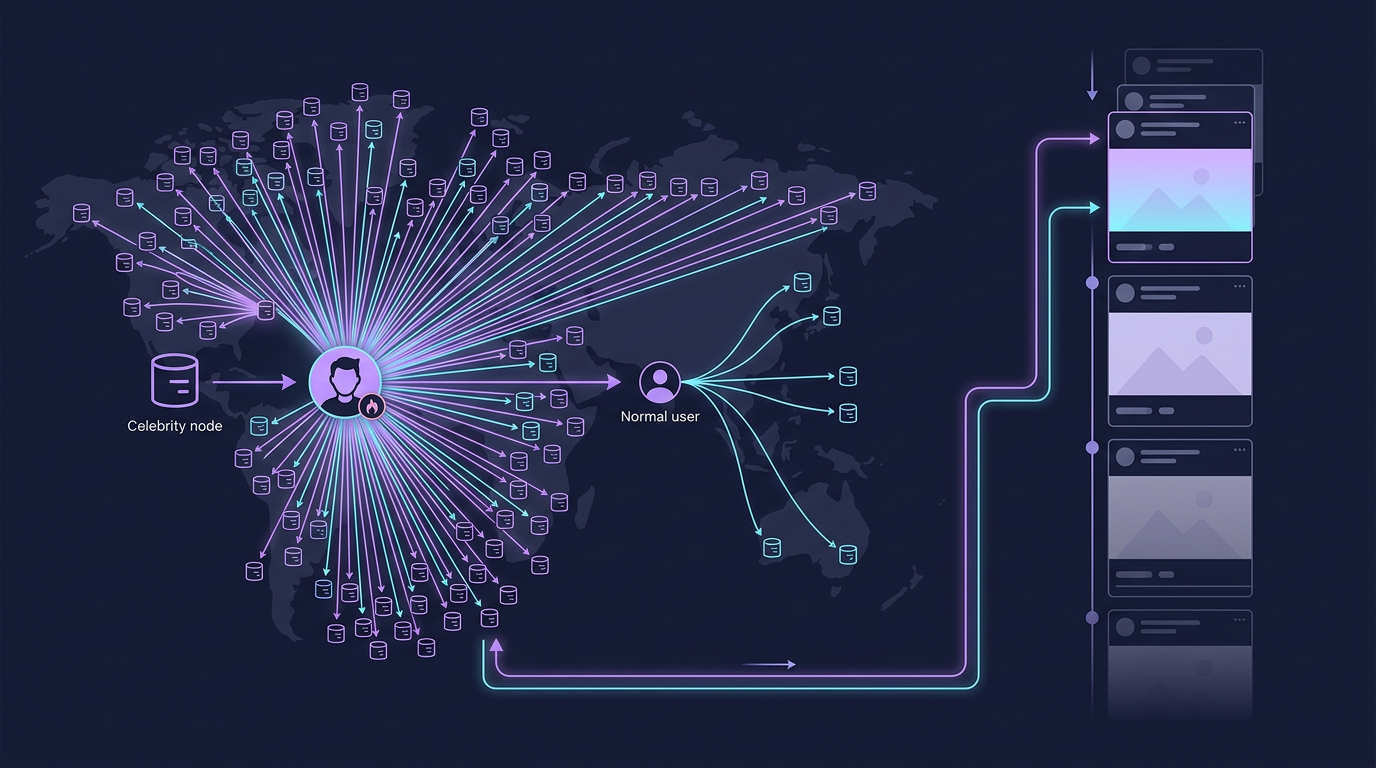
The news feed is the heartbeat of every social platform. Design it wrong and you either melt your database on every celebrity tweet or make users wait seconds for stale content. Design it right and 500 million people see a fresh, ranked timeline in under 200ms.
Mind Map
Overview
The social media feed — Twitter's timeline, Instagram's home feed, Facebook's news feed — is arguably the #2 most common system design interview question (behind URL shortener). It combines read-heavy access patterns, complex fan-out mechanics, ranking algorithms, and real-time notification delivery at massive scale.
What makes it hard:
- The "celebrity problem": a post from a user with 50M followers must fan-out to 50M caches in milliseconds
- Feed reads must complete in <200ms globally despite fetching, merging, and ranking dozens of posts
- Delete and edit propagation must retroactively update precomputed caches
- Social graphs grow unboundedly — following relationships cannot live in one database
Real-world examples: X (formerly Twitter), Instagram, Facebook, TikTok, LinkedIn all face these exact tradeoffs. Twitter open-sourced their fan-out architecture before the X transition. Instagram's early feed was pure pull; they moved to hybrid after scale issues. As of 2026, the push/pull hybrid (fan-out on write for normal users, pull at read time for celebrities) remains the production standard across major platforms.
Cross-references:
- Capacity estimation methodology → Chapter 4
- Redis caching patterns → Chapter 7
- SQL post storage → Chapter 9
- Graph/NoSQL for social graph → Chapter 10
- Kafka async fan-out pipeline → Chapter 11
Step 1: Requirements & Constraints
Functional Requirements
| # | Requirement | Notes |
|---|---|---|
| F1 | Create a post (text, images, videos) | Up to 280 chars text + optional media |
| F2 | Follow / unfollow users | Asymmetric (Twitter-style) |
| F3 | News feed timeline — see posts from followed users | Sorted by relevance or recency |
| F4 | Like, repost, comment on posts | Engagement signals for ranking |
| F5 | Real-time push notifications for mentions, likes, new posts | Push + in-app |
| F6 | Search posts and users | Out of scope for this chapter |
Non-Functional Requirements
| Attribute | Target | Rationale |
|---|---|---|
| Scale | 500M DAU, 1B posts/day | Twitter-tier |
| Feed load latency | < 200ms P99 | UX expectation |
| Post write latency | < 500ms | Perceived immediacy |
| Availability | 99.99% | Core product feature |
| Consistency | Eventual OK | Feed staleness < 5s acceptable |
| Fan-out followers | Avg 200, max 100M+ (celebrities) | Drives hybrid design |
Out of Scope
- Video transcoding pipeline (see Chapter 21)
- Full-text search indexing
- Ads insertion and auction system
- Content moderation ML pipeline (mentioned in production section)
Step 2: Capacity Estimation
Full methodology in Chapter 4. These are back-of-envelope figures.
QPS Estimates
DAU = 500M users

Feed reads:
  500M users × 10 feed views/day = 5B reads/day
  5B ÷ 86,400s = ~58,000 reads/s (58K RPS)
  Peak (2× avg) = ~116K RPS

Post writes:
  1B posts/day ÷ 86,400s = ~11,600 writes/s
  Peak = ~25K WPS

Fan-out writes (push model):
  11,600 posts/s × 200 avg followers = ~2.3M feed writes/s
(This is why naive push fan-out is dangerous)Storage Estimates
Post storage (SQL):
  1B posts/day × 1KB avg = 1 TB/day
  1 year = ~365 TB of post data

Media storage (object storage):
  ~10% of posts contain images (100M images/day)
  avg image 200KB → 20 TB/day in S3
  avg video 5MB, 1% of posts → 50 TB/day in S3

Feed cache (Redis):
  Per user: 20 post IDs × 8 bytes = 160 bytes
  500M users × 160 bytes = 80 GB
  In practice store 200 post IDs → 800 GB
  (Fits in a Redis cluster — well within budget)

Social graph:
  500M users × 200 avg follows × 8 bytes = 800 GB
Use sharded adjacency list or graph DBFanout Factor
Normal user: avg 200 followers → 200 cache writes per post
Power user:  10K followers → 10K cache writes
Celebrity:   50M followers → 50M cache writes (AVOID push model)

At 11.6K posts/s with avg 200 followers:
Fan-out write rate = 2.3M cache writes/s — manageable with Redis pipelineStep 3: High-Level Design
Data flow summary:
- User creates post → Post Service writes to PostgreSQL + publishes event to Kafka
- Fan-out Service consumes event → reads follower list from Graph DB → writes post ID to each follower's feed cache in Redis
- Feed Service serves reads → fetches post IDs from Redis → hydrates with post content from PostgreSQL or post cache
- Notification Service consumes event → sends push notifications to mentioned/following users
Step 4: Detailed Design
4.1 Fan-out on Write (Push Model)
When a user posts, precompute and push the post ID into every follower's feed cache.
Pros:
- Feed reads are O(1) — just read from Redis sorted set
- No computation at read time
- P99 feed latency easily <50ms
Cons:
- Writes amplified by follower count (celebrity problem)
- Wasted work if follower never opens the app
- Deletes/edits require retroactive cache invalidation across N caches
Celebrity problem: A post from an account with 50M followers requires 50M Redis ZADD operations. At ~100μs per Redis write, that's 5,000 seconds serially — impossible.
4.2 Fan-out on Read (Pull Model)
When a user opens their feed, dynamically pull recent posts from every followed user, merge, and rank.
Pros:
- No fan-out writes — post write is lightweight
- Celebrities treated same as normal users
- No wasted computation for inactive users
Cons:
- N database reads per feed request (N = number of followings)
- Feed load latency scales with follow count — users following 2000 accounts see slow feeds
- Thundering herd: same celebrity's posts fetched independently by every follower
4.3 Hybrid Approach (Production Choice)
Push for normal users, pull for celebrities. Define "celebrity" as users with >10K followers.
How it works at read time:
- Read pre-computed feed from Redis (normal users' posts already fanned-out)
- Identify celebrities the user follows (from a small celebrity set in a separate cache)
- Fetch recent posts from those celebrities directly from post cache
- Merge all posts, deduplicate by post_id, apply ranking, paginate
4.4 Comparison Table
| Dimension | Push (Fan-out on Write) | Pull (Fan-out on Read) | Hybrid |
|---|---|---|---|
| Feed read latency | Very low (cache hit) | High (N DB reads) | Low |
| Write amplification | High (follower count) | None | Low-medium |
| Celebrity problem | Severe | None | Handled separately |
| Storage cost | High (Redis per user) | Low | Medium |
| Complexity | Medium | Low | High |
| Inactive user waste | Yes | No | Minimal |
| Delete/edit propagation | Hard (N caches) | Easy (source of truth) | Medium |
| Production use | Normal users | Never alone at scale | Twitter, Instagram |
4.5 Feed Ranking
Chronological (Simple)
Sort by post.created_at DESC. Predictable, transparent, zero ML complexity. Suitable for MVP and interview answers.
Algorithmic (Production)
Score each candidate post by an engagement model:
score(post) = w1 × recency_score
            + w2 × like_rate
            + w3 × comment_rate
            + w4 × repost_rate
            + w5 × user_affinity(viewer, author)
+ w6 × content_type_boost # video > image > textPractical implementation:
- Pre-rank in fan-out service at write time (store score as Redis sorted set score instead of timestamp)
- Re-rank at read time using a lightweight ML model (ONNX runtime, <5ms latency budget)
- A/B test ranking models per user cohort
Feed ranking pipeline:
4.6 Database Choices
Why these choices:
| Store | Technology | Reason |
|---|---|---|
| Posts | PostgreSQL | ACID writes, complex queries, familiar ops tooling. See Ch 9 |
| Media | S3 + CloudFront | Immutable blob, CDN offloads bandwidth |
| Social graph | PostgreSQL (adjacency list at <1B edges) or Neo4j | For most companies, a follows(follower_id, followee_id) table suffices. See Ch 10 |
| Feed timeline | Redis sorted sets | ZADD feed:{uid} score post_id, ZREVRANGE for reads. O(log N) insert, O(M) reads |
| Post cache | Redis string / Memcached | Avoid repeat PostgreSQL hits for hydration |
Redis sorted set feed schema:
Key:   feed:{user_id}
Score: unix timestamp (or ranking score)
Value: post_id

ZADD feed:user123 1710000000 post456
ZREVRANGE feed:user123 0 49 → top 50 posts by recency4.7 Notification System
Key design decisions:
- Notifications are fire-and-forget — lose one notification, do not crash the feed
- User preferences stored in Redis (O(1) read per notification)
- Deduplication: if Alice likes 5 of Bob's posts in 10 minutes, batch into "Alice liked 5 of your posts" — use a time-windowed aggregation buffer in the notification service
- Rate limiting: max 10 push notifications per user per hour to prevent spam
Step 5: Deep Dives
5.1 Sharding User Data
Posts table and feed cache must be sharded as they grow beyond single-node limits.
Sharding strategy: by user_id using consistent hashing
shard = hash(user_id) % num_shards

For PostgreSQL:
  users 0-999K   → shard 0 (postgres-0)
  users 1M-1.99M → shard 1 (postgres-1)
  ...

For Redis feed cache:
  Redis Cluster handles this automatically via hash slots
Key: feed:{user_id} → hash slot from user_id portionHotspot mitigation:
- Celebrity users on their own shard (manual override)
- Read replicas absorb read traffic for popular shards
- Post cache in front of PostgreSQL eliminates most direct DB reads
Cross-shard feed reads:
- Feed Service reads fan-out cache from Redis (single shard per user)
- Post hydration may span shards — use async parallel fetches, join in application layer
5.2 Feed Generation Pipeline (Kafka-based)
Full Kafka patterns in Chapter 11.
Kafka partition key: author_id ensures all events for one author go to the same partition, maintaining ordering. Fan-out workers use consumer groups — multiple workers share the partition load.
Back-pressure handling:
- If fan-out lag grows (Kafka consumer lag metric), spin up additional fan-out worker replicas
- Prioritize active users (last login < 24h) — skip feed writes for dormant accounts
5.3 Cache Warming for Popular Users
New deployment or Redis node failure means cold caches. Strategy:
- Warm on first read: Feed Service detects cache miss → triggers async warm job → returns slightly slower first response → subsequent reads are fast
- Pre-warm on login: When user authenticates, enqueue a background warm job
- Celebrity post burst: When a verified celebrity posts, fan-out service pre-warms top 1% most-active followers synchronously before async bulk fan-out completes
5.4 Handling Deletes and Edits
Post deletions are hard with fan-out because the post_id lives in potentially millions of caches.
Delete strategy:
- Soft-delete the post in PostgreSQL (
deleted_at = now()) - Publish
post_deletedevent to Kafka - Fan-out service consumes event →
ZREM feed:{follower_id} post_idfor each follower's cache - Feed Service also checks soft-delete flag during post hydration — belt-and-suspenders
Edit strategy:
- Update post in PostgreSQL (keep edit history in
post_editstable) - Invalidate post from post cache:
DEL post:{post_id} - No need to touch feed caches — they store post IDs, not content
- Next hydration fetch will get updated content from PostgreSQL
Key insight: Store only post IDs in feed caches (not serialized post content). This makes edits trivial — the content is fetched fresh from the post cache/DB on every feed load.
Production Considerations
Monitoring
| Metric | Alert Threshold | What It Indicates |
|---|---|---|
| Feed read P99 latency | > 200ms | Redis cache miss rate high, or post hydration slow |
| Fan-out consumer lag (Kafka) | > 30s | Fan-out workers overwhelmed, need scaling |
| Redis memory utilization | > 70% | Feed cache eviction starting, extend TTL strategy |
| Cache hit ratio (feed) | < 90% | Cold cache problem, warm-on-login needed |
| Post write error rate | > 0.1% | PostgreSQL issues |
| Notification delivery rate | < 99% | APNs/FCM integration issues |
Failure Modes
Fan-out service down:
- Kafka accumulates messages (no data loss — see Ch 11)
- Users see stale feeds until service recovers
- Feed Service falls back to pull model for all users temporarily
- Recovery: service restarts, processes Kafka backlog, caches repopulate
Redis cluster node failure:
- Redis Cluster automatic failover (<30s with replica promotion)
- Affected users' feeds are cold — Feed Service falls back to pull from PostgreSQL
- Cache warms on next read
- Impact: elevated latency for <0.01% of users for ~30 seconds
Database (PostgreSQL) overload:
- Read replicas absorb 95%+ of traffic (post hydration reads)
- Circuit breaker in Feed Service: if DB latency >500ms, serve cached-only feed with stale data
- Write path (post creation) has separate connection pool — isolated from read failures
Cost Analysis
Redis memory at scale:
- 500M users × 200 post IDs × 8 bytes = 800 GB
- Redis cluster: ~8× r7g.2xlarge nodes at ~$0.60/hr each = ~$4,300/month
- Trade-off: saves ~58K QPS of PostgreSQL reads
Kafka throughput:
- 2.3M fan-out writes/s → ~3 Kafka partitions per topic sufficient for fan-out events
- Cost: ~$500/month on managed Confluent Cloud at this scale
Total rough infra cost estimate (Twitter-tier):
- Redis: ~$50K/month
- PostgreSQL (sharded, replicated): ~$100K/month
- S3 + CDN: ~$200K/month (media-heavy)
- Kafka: ~$10K/month
- Compute (services): ~$80K/month
- Total: ~$440K/month — consistent with public estimates for mid-size social platforms
Content Moderation Pipeline
Production social feeds require async content moderation before posts become visible:
Post created → [async] → Image/Text ML classifier → {SAFE | REVIEW | BLOCK}
                                                        ↓         ↓        ↓
Fan-out Human queue Delete- Safe posts: immediate fan-out (optimistic)
- Flagged posts: held from fan-out, routed to human review queue
- Blocked posts: soft-deleted before any fan-out occurs
- False positive recovery: if human reviewer clears a held post, trigger delayed fan-out
Key Takeaway
The social media feed is a study in making trade-offs explicit. Push fan-out gives fast reads but creates the celebrity problem. Pull fan-out eliminates write amplification but makes reads expensive. The hybrid approach — push for normal users, pull for celebrities at read time — is what every major platform settled on. Redis sorted sets are the canonical tool for per-user feed caches. Kafka decouples the fan-out pipeline from the write path, enabling horizontal scaling without blocking the user. And storing post IDs (not content) in feed caches keeps deletes and edits manageable.
Related Chapters
| Chapter | Relevance |
|---|---|
| Ch07 — Caching | Redis sorted sets for per-user feed cache storage |
| Ch09 — SQL Databases | Post/user DB schema and follower graph queries |
| Ch11 — Message Queues | Kafka fan-out pipeline decoupling write from feed delivery |
| Ch08 — CDN | CDN delivery for media (images, video) in feed posts |
Practice Questions
Beginner
Celebrity Threshold: At what follower count should the hybrid model switch from push fan-out to pull-on-read for a celebrity user's posts? How would you measure the right threshold empirically for your specific workload?
Hint
The threshold is where fan-out write amplification (followers × write latency) exceeds the cost of a pull-on-read merge — measure p99 write latency for fan-out at different follower counts in a load test, then set the threshold just below where latency degrades.
Intermediate
Feed Staleness: A user follows 500 people. The system uses push fan-out with an async worker pool. The user opens their app 2 seconds after someone they follow posts. What is the worst-case feed staleness, and what factors in your pipeline determine it?
Hint
Staleness = time in queue + fan-out processing time for 500 followers; under normal load this is sub-second, but under a write spike, worker queue depth increases — monitor queue lag as the leading indicator of feed staleness.Delete Propagation: A post from a user with 10K followers is reported and must be removed within 60 seconds. Walk through every system that contains a reference to this post (feed caches, CDN, search index, notification service, activity log) and the order in which you update each.
Hint
Prioritize the user-facing read path first (invalidate Redis feed caches, CDN purge); then async cleanup of notifications and search index; the activity log is append-only and records the deletion event rather than being modified.Redis Cluster Failure: Your Redis feed cache cluster loses 20% of its nodes in a network partition. What happens to feed reads for users whose feeds were on the failed nodes? Describe your fallback strategy step by step, including how you rebuild the cache after recovery.
Hint
Cache misses fall back to the write-side database (posts table + follow graph); this increases DB read load — use a read replica and limit fallback concurrency with a semaphore; rebuild cache lazily on the next successful read after nodes recover.
Advanced
Feed Ranking Pipeline: Design a feed ranking system that incorporates user affinity scores (how often Alice engages with Bob's posts). Where do you store affinity scores, how do you update them after each engagement event, and how do you incorporate them into the ranking pipeline within a 200ms total latency budget?
Hint
Store affinity scores in Redis (fast reads); update asynchronously via a Kafka consumer after each engagement event; at ranking time, fetch the top-K candidate posts from the feed cache, score them with affinity weights in-memory, and sort — the ranking computation itself must complete in < 50ms to fit the budget.
Next: Chapter 20 — Chat & Messaging System
References & Further Reading
- System Design Interview — Alex Xu, Chapter 11 (News Feed)
- Serving Facebook Multifeed — Lars Backstrom et al.
- Twitter's Timeline Architecture — InfoQ
- Scaling Instagram Infrastructure — Instagram Engineering
- Facebook TAO: Distributed Data Store for the Social Graph
Comments powered by Giscus. Enable GitHub Discussions on the repo to activate.