Chapter 12: Communication Protocols
Mind Map
OSI Model Quick Reference
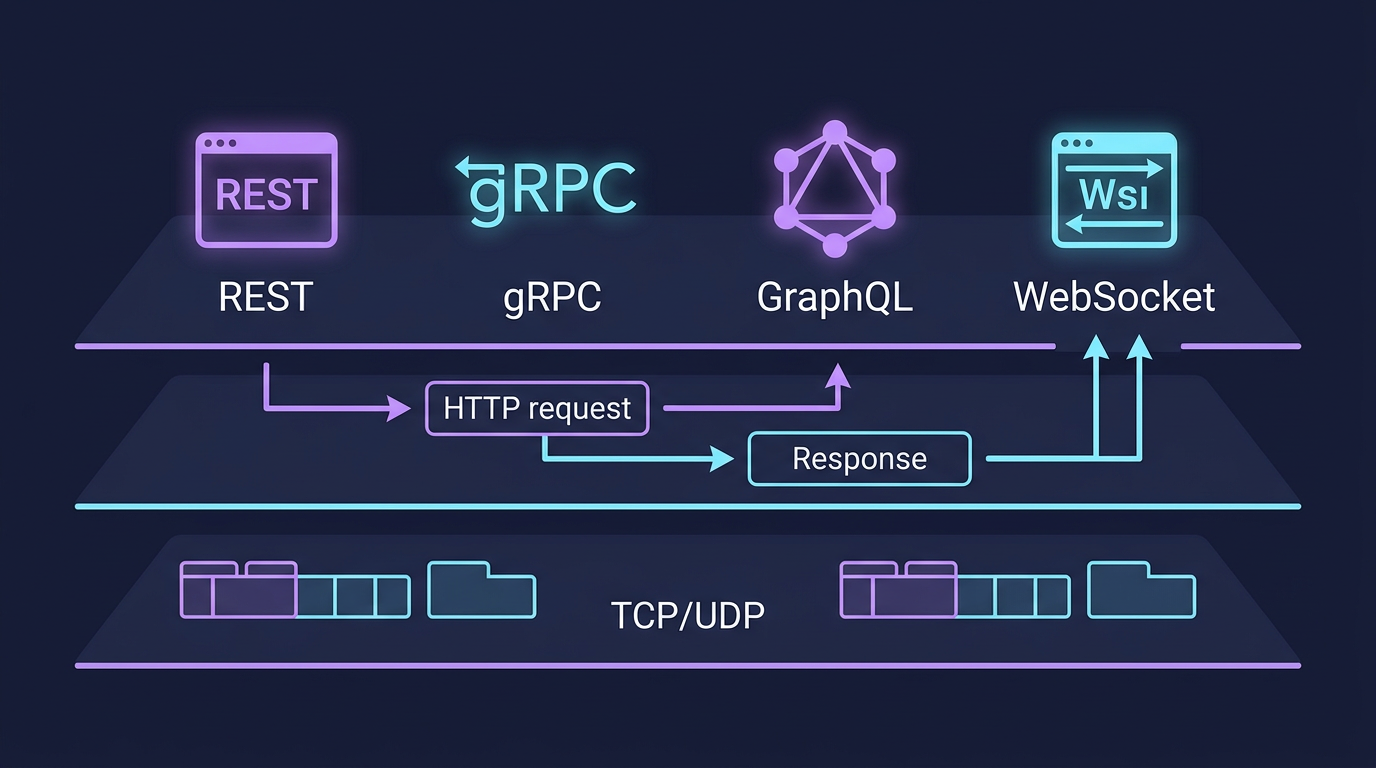
Each protocol covered in this chapter maps to a specific layer in the OSI model. Understanding the layer tells you what guarantees the protocol provides and what it delegates downward.
| Layer | Name | Protocols Covered Here | Responsibility |
|---|---|---|---|
| 7 | Application | HTTP, REST, GraphQL, gRPC, WebSocket | Business logic framing, data semantics |
| 6 | Presentation | TLS/SSL (HTTPS) | Encryption, encoding, compression |
| 5 | Session | WebSocket (session management) | Session establishment, maintenance |
| 4 | Transport | TCP, UDP | End-to-end delivery, ports, reliability |
Layers 1–3 (Physical, Data Link, Network) handle raw bit transmission, framing, and IP routing — below the scope of this chapter but assumed by everything above.
TCP vs UDP
TCP and UDP are the two dominant Layer 4 protocols. Every application-layer protocol (HTTP, WebSocket, gRPC) rides on one of them. Choosing the right one shapes the latency, reliability, and complexity of your system.
TCP: Connection-Oriented Reliability
TCP guarantees ordered, reliable byte-stream delivery through a connection established by the three-way handshake before any data flows.
The handshake adds 1.5 RTT of latency before the first byte of data. For HTTPS over TCP, TLS adds another 1–2 RTTs on top. This overhead is acceptable for most request-response workloads but becomes painful for latency-sensitive or short-lived connections.
TCP key mechanisms:
- Sequence numbers — detect lost, reordered, or duplicated segments
- Sliding window — flow control prevents the sender from overwhelming the receiver
- Congestion control — CUBIC/BBR algorithms back off when packet loss is detected
- Retransmission — lost segments trigger retransmit with exponential backoff
UDP: Connectionless Speed
UDP sends datagrams with no handshake, no acknowledgment, no ordering, and no retransmission. The sender fires and forgets. This minimizes latency at the cost of reliability.
UDP key properties:
- No connection setup — first packet arrives in 0.5 RTT
- No head-of-line blocking — each datagram is independent
- Applications must implement their own error handling if needed
- Supports broadcast and multicast (TCP cannot)
Comparison Table
| Dimension | TCP | UDP |
|---|---|---|
| Connection | Connection-oriented (handshake required) | Connectionless (no handshake) |
| Reliability | Guaranteed delivery via ACKs + retransmit | Best-effort — packets may be lost |
| Ordering | Guaranteed in-order delivery | No ordering guarantee |
| Error detection | Checksum + retransmission | Checksum only (no recovery) |
| Speed / Latency | Higher latency (handshake + ACK overhead) | Lower latency (fire-and-forget) |
| Overhead | 20-byte header + window/ACK fields | 8-byte header |
| Flow control | Built-in (sliding window) | None (application responsibility) |
| Congestion control | Built-in (CUBIC, BBR, Reno) | None |
| Head-of-line blocking | Yes — one lost segment blocks stream | No — datagrams are independent |
| Broadcast/Multicast | No | Yes |
| Typical use cases | HTTP, email, file transfer, SSH, databases | DNS, VoIP, video streaming, gaming, QUIC |
Rule of thumb: If losing data means the application breaks (financial transactions, file uploads), use TCP. If delivering stale data is worse than delivering no data (live video frame, game position update), use UDP.
HTTP and HTTPS
HTTP is the foundation of data exchange on the web. It operates as a request-response protocol over TCP (or QUIC for HTTP/3).
Request/Response Model
Every HTTP exchange follows the same shape:
Client → Request (Method + URI + Headers + Body)
Server → Response (Status Code + Headers + Body)HTTP verbs and their semantics:
| Verb | Idempotent | Safe | Purpose |
|---|---|---|---|
| GET | Yes | Yes | Retrieve resource |
| HEAD | Yes | Yes | Retrieve headers only |
| POST | No | No | Create resource or trigger action |
| PUT | Yes | No | Replace resource entirely |
| PATCH | No | No | Partial update |
| DELETE | Yes | No | Remove resource |
| OPTIONS | Yes | Yes | Describe communication options |
Idempotent = calling N times produces the same result as calling once. Safe = no side effects on the server.
HTTP/1.1 vs HTTP/2 vs HTTP/3
| Feature | HTTP/1.1 | HTTP/2 | HTTP/3 |
|---|---|---|---|
| Transport | TCP | TCP | QUIC (UDP) |
| Multiplexing | No (one request per connection, or pipelining) | Yes — multiple streams over one connection | Yes — independent streams |
| Head-of-line blocking | Yes (at application layer) | Partially (TCP level HoL remains) | No (QUIC streams are independent) |
| Header compression | None | HPACK | QPACK |
| Server push | No | Yes | Yes |
| Connection setup | 1.5 RTT (TCP) + TLS | 1.5 RTT + TLS | 1 RTT or 0-RTT (QUIC + TLS 1.3) |
| Binary protocol | No (text) | Yes | Yes |
| Typical adoption | Legacy/fallback | Dominant (95%+ servers) | Widely deployed — CDNs, browsers; gains are use-case dependent |
Key HTTP/2 improvements explained:
- Multiplexing — multiple request/response pairs share a single TCP connection via numbered streams. Eliminates the need for connection pooling hacks.
- Header compression (HPACK) — repeated headers (e.g.,
Cookie,Authorization) are sent as indexed references, reducing overhead by 85–95%. - Keep-alive — HTTP/1.1 introduced persistent connections (keep-alive), but HTTP/2 makes this the default and adds multiplexing on top.
HTTP/3 and QUIC:
HTTP/3 replaces TCP with QUIC, a transport protocol built on UDP. QUIC integrates TLS 1.3, providing 0-RTT reconnection for returning clients and eliminating TCP's head-of-line blocking at the transport layer — the last bottleneck HTTP/2 could not address.
HTTP/3 adoption is nuanced — it is not universally faster
As of 2026, HTTP/3 is widely deployed across major CDNs and browsers (95%+ browser support; ~34% of the top 10M sites). However, performance gains are use-case dependent:
- Where HTTP/3 wins: High packet-loss environments (mobile, unreliable Wi-Fi), long-distance connections with many hops, high-concurrency short-lived connections.
- Where HTTP/3 can underperform: Very high-bandwidth links (>500 Mbps fiber), CPU-bound servers handling many QUIC connections simultaneously (QUIC's per-packet encryption is more CPU-intensive than TCP + TLS), and environments where UDP is rate-limited by network policy.
Frame HTTP/3 as the right tool for lossy/mobile paths and global CDN edge — not as an unconditional upgrade from HTTP/2 on fast internal networks. Benchmark your specific workload before switching origin-to-origin traffic to QUIC.
REST
REST (Representational State Transfer) is an architectural style for designing networked APIs, not a protocol. It runs over HTTP but imposes constraints that make APIs predictable and scalable.
Core Constraints
- Client-Server — UI and data storage are separated; clients don't know about server internals
- Stateless — each request contains all information needed; no server-side session state
- Cacheable — responses explicitly declare whether they are cacheable
- Uniform Interface — resource-based URIs, standard HTTP verbs, self-descriptive messages
- Layered System — clients cannot tell if they are connected directly to the origin server
- HATEOAS — responses include links to related actions (rarely implemented in practice)
Resource-Based URI Design
# Good: noun-based, hierarchical
GET  /users/42              → fetch user 42
GET  /users/42/orders       → fetch user 42's orders
POST /users                 → create new user
PUT  /users/42              → replace user 42
DELETE /users/42/orders/7   → delete order 7 of user 42

# Bad: verb-based (RPC-style)
POST /getUser
POST /deleteOrder
GET /createUserRichardson Maturity Model
The Richardson Maturity Model grades REST API quality from 0 to 3:
| Level | Name | Description | Example |
|---|---|---|---|
| 0 | Swamp of POX | Single URI, single verb | POST /api with all operations |
| 1 | Resources | Multiple URIs for resources | GET /users/42 |
| 2 | HTTP Verbs | Correct use of GET, POST, PUT, DELETE | Standard REST |
| 3 | Hypermedia (HATEOAS) | Responses include links to next actions | {"user": {...}, "links": {"orders": "/users/42/orders"}} |
Most production APIs operate at Level 2. Level 3 (HATEOAS) is theoretically ideal but rarely warranted — the link-following overhead adds complexity without proportional benefit for most clients.
REST Best Practices and Common Mistakes
Best practices:
- Use plural nouns for collections (
/users, not/user) - Return appropriate HTTP status codes (200, 201, 400, 404, 409, 422, 500)
- Version your API (
/v1/users) or viaAcceptheader - Use query parameters for filtering/sorting (
GET /users?role=admin&sort=name) - Return a consistent error envelope:
{"error": {"code": "USER_NOT_FOUND", "message": "..."}}
Common mistakes:
- Using
GETfor operations with side effects (breaks caching and idempotency) - Ignoring HTTP status codes (always returning 200 with error in body)
- Deeply nested URIs beyond 2–3 levels (
/companies/1/departments/5/teams/3/members/9) - Exposing internal IDs or database schema in URLs
- Not paginating large collection responses
RPC (Remote Procedure Call)
RPC abstracts the network call to look like a local function call. The calling code invokes a function — the serialization, network transport, and deserialization are handled by generated stubs.
How RPC Works
The generated stubs handle all marshaling. From the developer's perspective, calling a remote service looks identical to a local function call — with the important caveat that network calls can fail in ways local calls cannot (timeouts, partial failures, retries).
gRPC: Modern RPC with Protocol Buffers
gRPC is Google's open-source RPC framework. It uses Protocol Buffers (protobuf) for serialization and runs over HTTP/2, unlocking streaming, multiplexing, and header compression.
Defining a service with protobuf:
syntax = "proto3";

service UserService {
  rpc GetUser (GetUserRequest) returns (User);
  rpc ListUsers (ListUsersRequest) returns (stream User);
  rpc CreateUser (stream CreateUserRequest) returns (CreateUserResponse);
  rpc Chat (stream ChatMessage) returns (stream ChatMessage);
}

message GetUserRequest { int64 user_id = 1; }
message User {
  int64 id = 1;
  string name = 2;
  string email = 3;
}The .proto file is the source of truth — protoc generates type-safe client and server stubs in 10+ languages.
gRPC Architecture
gRPC streaming modes:
| Mode | Direction | Use Case |
|---|---|---|
| Unary | Client → Server, one response | Standard request-response (GetUser) |
| Server streaming | Client → Server, N responses | Large result sets, live feeds (ListUsers stream) |
| Client streaming | N messages → Server, one response | File upload, batch ingestion |
| Bidirectional streaming | N messages ↔ N messages | Chat, real-time collaboration |
gRPC advantages over REST:
- 2–5x smaller payload — protobuf binary vs JSON text
- ~10x faster serialization — protobuf encoding/decoding is significantly faster
- Strongly typed contract —
.protofile acts as an API contract, breaking changes are caught at compile time - Native streaming — no polling or chunked transfer hacks needed
- Built-in deadlines and cancellation — propagated across service boundaries
GraphQL
GraphQL is a query language and runtime for APIs, developed by Facebook (2012, open-sourced 2015). Unlike REST's resource-based model, GraphQL exposes a typed schema and lets clients declare exactly what data they need.
Core Concepts
Single endpoint: All operations go through POST /graphql. The operation type (query, mutation, subscription) is declared in the request body.
Client-driven queries — no over-fetching or under-fetching:
# REST: GET /users/42 returns ALL user fields (over-fetching)
# GraphQL: ask for exactly what you need
query {
  user(id: 42) {
    name
    email
    orders(last: 3) {
      id
      total
      status
    }
  }
}Schema-first design:
type User {
  id: ID!
  name: String!
  email: String!
  orders(last: Int): [Order!]!
}

type Order {
  id: ID!
  total: Float!
  status: OrderStatus!
}

type Query {
  user(id: ID!): User
  users(role: String): [User!]!
}

type Mutation {
  createUser(input: CreateUserInput!): User!
}

type Subscription {
  orderUpdated(userId: ID!): Order!
}Advantages
- No over-fetching — clients get exactly the fields they request
- No under-fetching — multiple related resources in a single round-trip
- Strong typing — the schema is a living contract; introspection enables auto-generated docs
- Subscriptions — real-time updates over WebSocket using the same schema
When to Use GraphQL vs REST
| Situation | Recommendation |
|---|---|
| Public API consumed by unknown clients | REST (simpler, better CDN caching) |
| Mobile app with bandwidth constraints | GraphQL (precise field selection) |
| Dashboard aggregating many data sources | GraphQL (single round-trip joins) |
| Multiple client types with different data needs | GraphQL (BFF pattern) |
| Simple CRUD with uniform data shapes | REST (lower overhead) |
| Need aggressive HTTP caching | REST (GET-based, cache-friendly) |
| Rapidly evolving schema, many frontend teams | GraphQL (no versioning needed) |
Real-world: GitHub migrated their public API to GraphQL (v4) — clients can fetch a PR with its reviews, comments, and CI status in a single query that previously required 5–10 REST calls.
WebSockets
HTTP's request-response model requires the client to initiate every exchange. For real-time applications — chat, live dashboards, multiplayer games — polling is wasteful and slow. WebSockets solve this with a persistent, full-duplex TCP connection where either side can send messages at any time.
WebSocket Upgrade Handshake
WebSockets reuse the HTTP port (80/443) and begin with an HTTP upgrade request, ensuring compatibility with existing proxies and firewalls.
The Sec-WebSocket-Key / Sec-WebSocket-Accept exchange prevents cache poisoning by ensuring the server genuinely understands the WebSocket protocol.
WebSocket Message Framing
WebSocket messages are sent as frames — a lightweight binary envelope (2–14 byte header) wrapping the payload. Frames can carry text (UTF-8) or binary data. Large messages are split into multiple frames and reassembled.
Use Cases
| Use Case | Why WebSocket fits |
|---|---|
| Chat applications | Server pushes messages to all clients instantly |
| Live sports / financial tickers | High-frequency server-to-client updates |
| Collaborative editing | Bi-directional, low-latency document sync |
| Multiplayer gaming | Sub-100ms position/state updates |
| Live notifications | Push events without polling |
| IoT device telemetry | Persistent connection for sensor data |
Cross-reference: The chat system design in Chapter 20 is built on WebSockets — this chapter explains the underlying mechanics.
WebSocket vs Server-Sent Events (SSE)
If you only need server-to-client push (live dashboard, notifications), SSE is simpler — it's plain HTTP/1.1 with text/event-stream. Use WebSocket when you need bidirectional communication.
WebTransport (Emerging Bidirectional Transport)
WebTransport is a W3C specification that exposes QUIC-based bidirectional streams and datagrams directly to browser JavaScript, without the framing overhead of the WebSocket handshake. As of early 2026 it reached baseline browser support: Chrome 97+, Firefox 114+, Edge 98+, and Safari 26.4 (shipped March 2026).
Key properties:
- Streams: Reliable, ordered, independently flow-controlled (no head-of-line blocking across streams — unlike WebSocket over TCP)
- Datagrams: Unreliable, unordered, sub-millisecond delivery — ideal for live video frames, game state, telemetry
- Connection establishment: QUIC 1-RTT (0-RTT for returning clients) — faster than WebSocket's HTTP upgrade handshake
- TLS: Mandatory and integrated into QUIC
When to use WebTransport over WebSocket:
| Scenario | WebSocket | WebTransport |
|---|---|---|
| Chat, collaborative editing (reliable, ordered) | Good fit | Stream API also works |
| Live video frame delivery (loss-tolerant) | Not suited | Datagram API ideal |
| Real-time game state (low latency > ordering) | Workable | Datagram API ideal |
| Needs broad compatibility (Safari pre-2026) | Better | Requires Safari 26.4+ |
| Simple request-response over persistent conn | Fine | Overkill |
WebTransport targets real-time media use cases where WebRTC's complexity is undesirable and WebSocket's TCP head-of-line blocking is problematic. It is a strong candidate for Media over QUIC (MOQ) streaming architectures aiming for sub-150ms end-to-end latency.
Status as of 2026
WebTransport spec is at W3C Candidate Recommendation stage (not yet an RFC). The API is stable but treat server-side library support as maturing — production readiness varies by ecosystem.
gRPC and the Connect Protocol
gRPC is production-stable in 2026 with 1,000+ companies in production use. One notable addition to the ecosystem is the Connect protocol developed by Buf (buf.build):
Connect is a protocol that is wire-compatible with gRPC and gRPC-Web but designed to eliminate browser friction:
- Works natively in browsers without a proxy (no Envoy or grpc-web proxy required)
- Falls back gracefully to HTTP/1.1 with
Content-Type: application/connect+json— making it inspectable with standard HTTP tools (curl, browser devtools) - Supports both Protobuf binary and JSON encoding
- Uses the same
.protofiles as gRPC — Connect is a transport, not a schema change
When to consider Connect:
- You want gRPC-style typed APIs callable from a browser without a proxy layer
- Your team wants to avoid the operational burden of Envoy just for browser-to-service gRPC
- You need gRPC for internal services but REST/Connect for browser clients — Connect lets you share the same
.protodefinitions for both
gRPC's HTTP/3 support remains experimental as of 2026 — standard deployments still use HTTP/2.
Protocol Selection Guide
Quick heuristics:
- Microservices talking to microservices → gRPC. Strongly typed, efficient, streaming-native. See Chapter 13 for how gRPC fits the microservices architecture.
- Public-facing API → REST first, migrate to GraphQL if clients have divergent data needs.
- Real-time two-way communication → WebSocket. Not HTTP polling.
- Video streaming, DNS, gaming → UDP (or QUIC/HTTP/3 which builds UDP-based reliability).
- File transfer, email, database connections → TCP. Reliability is mandatory.
Comprehensive Protocol Comparison
| Aspect | REST | gRPC | GraphQL | WebSocket |
|---|---|---|---|---|
| Underlying protocol | HTTP/1.1 or HTTP/2 | HTTP/2 | HTTP/1.1 or HTTP/2 | TCP (via HTTP upgrade) |
| Data format | JSON (typically) | Protocol Buffers (binary) | JSON | Any (text or binary) |
| Communication direction | Request-Response | Unary + Bidirectional streaming | Request-Response + Subscriptions | Full-duplex bidirectional |
| Schema / Contract | OpenAPI (optional) | .proto file (required) | GraphQL SDL (required) | None (application-defined) |
| Type safety | No (runtime) | Yes (compile time) | Yes (schema-validated) | No |
| Caching | Excellent (HTTP GET cache) | Limited (POST-based) | Limited (complex) | None |
| Browser support | Native | Via gRPC-Web proxy (or Connect protocol, no proxy) | Native | Native |
| Payload efficiency | Medium (JSON) | High (protobuf 2–5x smaller) | Medium (JSON, but precise) | Low overhead (framing) |
| Learning curve | Low | Medium | Medium | Low |
| Versioning | URL path or Accept header | Package versions in .proto | Schema evolution (additive) | N/A |
| Connection overhead | Per-request (or keep-alive) | Single persistent HTTP/2 conn | Per-request | Single persistent TCP |
| Best for | Public APIs, CRUD | Internal microservices | Mobile/frontend BFF | Chat, gaming, real-time |
| Real-world examples | Twitter API, Stripe | Google internal, Kubernetes | GitHub API v4, Shopify | Slack, Discord, trading apps |
Real-World Examples
gRPC at Google
Google uses gRPC as the backbone for internal service-to-service communication across their entire infrastructure — Search, Ads, Maps, and beyond. Before gRPC, teams used Stubby, Google's internal RPC system. gRPC was designed as Stubby's open-source successor.
Key benefits Google realized:
- Single IDL (
.proto) replaces ad-hoc API documentation across thousands of services - Code generation eliminates hand-written serialization bugs
- Bidirectional streaming enables real-time feeds without polling
- Deadline propagation — a deadline set at the edge propagates through every downstream call, preventing cascading timeouts
GraphQL at GitHub API v4
GitHub's v3 REST API required multiple round-trips to gather data for a single page. Loading a PR required: GET /repos/{owner}/{repo}/pulls/{num}, then separate calls for reviews, comments, CI statuses, and labels.
GitHub's GraphQL API v4 collapses this into a single operation:
query {
  repository(owner: "facebook", name: "react") {
    pullRequest(number: 26000) {
      title
      author { login }
      reviews(first: 5) { nodes { state author { login } } }
      commits(last: 1) { nodes { commit { statusCheckRollup { state } } } }
    }
  }
}Result: fewer round-trips, reduced bandwidth (especially for mobile clients), and a type-safe contract that prevents breaking changes through schema evolution rather than versioning.
Key Takeaway
Protocol choice is an architectural decision, not a preference. TCP when reliability is non-negotiable. UDP when latency beats correctness. REST for public APIs that need caching and simplicity. gRPC for internal microservices that need type safety and efficiency. GraphQL when multiple clients have divergent data requirements. WebSocket when the server needs to push data to clients without being asked. The wrong protocol doesn't just create technical debt — it creates operational ceilings you'll hit under load.
Protocol Sequence Diagrams
The following sequence diagrams show the exact message flow for each major protocol. Understanding the number of round-trips and the state transitions helps you reason about latency, connection overhead, and failure modes.
HTTP Request/Response — Full Flow with DNS
A complete HTTP request involves DNS resolution, TCP setup, TLS negotiation, and then the actual request. Each step adds latency.
Latency breakdown: DNS (~50ms, cached to ~0ms) + TCP handshake (1 RTT) + TLS 1.2 (2 RTT) + request (1 RTT) = ~4 RTT before first byte. HTTP/3 (QUIC + TLS 1.3) reduces this to 1 RTT or 0-RTT for returning clients.
WebSocket Lifecycle — From Upgrade to Close
WebSocket reuses the HTTP port and starts with an HTTP upgrade. Once upgraded, the connection becomes full-duplex and stays open.
gRPC Communication Patterns
gRPC supports four streaming patterns. Each maps to a different stream keyword in the .proto file.
| Pattern | Proto Syntax | Typical Use Case |
|---|---|---|
| Unary | rpc GetUser(Request) returns (Response) | Fetch a single record |
| Server streaming | rpc ListUsers(Request) returns (stream Response) | Paginated results, live feeds |
| Client streaming | rpc Upload(stream Chunk) returns (Summary) | File upload, batch ingestion |
| Bidirectional | rpc Chat(stream Msg) returns (stream Msg) | Real-time collaboration, chat |
Server-Sent Events (SSE) Flow
SSE is a simple HTTP mechanism for server-to-client push. It requires no upgrade — just a long-lived HTTP response with Content-Type: text/event-stream.
SSE vs WebSocket: SSE is unidirectional (server → client only) and simpler — it is just HTTP, so it works through all proxies, supports automatic reconnection via the EventSource API, and requires no special server infrastructure. Use SSE for dashboards, notifications, and live feeds. Use WebSocket when the client also needs to send data frequently.
Protocol Selection Decision Tree — Expanded
API Design Best Practices
REST API Design
Resource Naming
- Use nouns, not verbs:
/users/123not/getUser/123 - Use plural nouns for collections:
/usersnot/user - Nest for relationships:
/users/123/orders - Avoid deep nesting beyond 2–3 levels
HTTP Methods & Status Codes
| Method | Action | Idempotent | Safe | Success Code |
|---|---|---|---|---|
| GET | Read | Yes | Yes | 200 |
| POST | Create | No | No | 201 |
| PUT | Replace | Yes | No | 200 |
| PATCH | Partial update | No | No | 200 |
| DELETE | Remove | Yes | No | 204 |
Idempotent means calling the operation N times produces the same server state as calling it once. Safe means the operation has no side effects.
Idempotency in APIs
Network failures are unavoidable. When a client retries a failed request, the server must be able to detect duplicates and return the original result instead of executing the operation twice — critical for payment charges, order creation, and any non-reversible action.
Idempotency Keys
- Client generates a unique key per logical operation (typically a UUID)
- Client sends the key in the request header:
Idempotency-Key: <uuid> - Server stores the key alongside the result for a deduplication window (typically 24 hours)
- On retry with the same key, the server returns the cached response without re-executing
Without idempotency keys, a network timeout between the payment provider's success and the server's response to the client would cause a double charge on retry.
Real-world: Stripe uses idempotency keys on all payment mutations. The key must be unique per operation but stable across retries of the same operation.
Pagination Strategies
Large collections must be paginated — returning all records in one response creates unbounded response sizes and slow queries.
| Strategy | Pros | Cons | Best For |
|---|---|---|---|
| Offset / Limit | Simple, supports random access | Slow on large offsets (OFFSET 100000 scans 100k rows), inconsistent on concurrent inserts | Small datasets, admin panels |
| Cursor-based | Fast, stable results during concurrent writes | No random access, cursor must be stored by client | Infinite scroll, social feeds |
| Keyset | Fast, consistent, uses index directly | Cannot skip pages arbitrarily | Time-ordered data, append-heavy tables |
Offset example: GET /users?offset=200&limit=50
Cursor example: GET /users?after=dXNlcjoxMjM&limit=50 — the after value encodes the last seen ID (often base64-encoded) and is returned in the response alongside a next_cursor field.
Keyset example: GET /events?after_id=9823&limit=50 — the query is WHERE id > 9823 ORDER BY id LIMIT 50, which uses the primary key index directly with no full table scan.
API Versioning
As APIs evolve, breaking changes are unavoidable. Versioning strategies determine how clients and servers negotiate which version to use.
| Strategy | Example | Pros | Cons |
|---|---|---|---|
| URI path | /v1/users | Explicit, cacheable, easy to test in browser | "URL pollution," old paths must be maintained indefinitely |
| Accept header | Accept: application/vnd.api.v1+json | Clean URLs | Hidden from logs/proxies, harder to test manually |
| Query parameter | /users?version=1 | Easy to use | Messy, not semantically correct |
Recommendation: URI path versioning (/v1/, /v2/) is the most pragmatic choice for public APIs — it is explicit, cacheable, and trivially testable. Header versioning is preferred in strict REST purist circles but creates operational friction.
Additive changes (new optional fields, new endpoints) never require a version bump. Only breaking changes (removing fields, changing types, altering semantics) warrant a new version.
Error Response Design
Consistent, structured error responses let clients handle failures programmatically rather than parsing human-readable strings.
{
  "error": {
    "code": "VALIDATION_ERROR",
    "message": "Invalid email format",
    "details": [
      { "field": "email", "reason": "must be a valid email address" }
    ],
    "request_id": "req_abc123"
  }
}Key fields:
code— machine-readable error identifier, stable across versionsmessage— human-readable description, may changedetails— structured list for field-level validation errors (reduces client parsing work)request_id— correlates the error to server-side logs for debugging
Anti-pattern: Always returning 200 OK with an error in the body. This breaks HTTP caching, monitoring, and any middleware that relies on status codes.
When to Choose REST vs gRPC vs GraphQL
| Criteria | REST | gRPC | GraphQL |
|---|---|---|---|
| Primary use case | Public APIs, CRUD | Internal microservices | Frontend-driven queries |
| Protocol | HTTP/1.1 or HTTP/2 | HTTP/2 | HTTP |
| Payload format | JSON | Protobuf (binary) | JSON |
| Streaming | Limited (SSE for server push) | Bidirectional native | Subscriptions |
| Browser support | Native | Needs proxy (grpc-web) or Connect protocol (no proxy) | Native |
| Schema | OpenAPI (optional) | .proto (required) | SDL (required) |
| Type safety | Runtime only | Compile time | Schema-validated |
| Learning curve | Low | Medium | Medium-High |
Go Implementation Example
The following shows a minimal HTTP REST server alongside a WebSocket echo server — the two most common server-side protocol implementations.
package main

import (
	"encoding/json"
	"fmt"
	"log"
	"net"
	"net/http"
)

// --- HTTP REST server ---

type User struct {
	ID   int    `json:"id"`
	Name string `json:"name"`
}

func usersHandler(w http.ResponseWriter, r *http.Request) {
	w.Header().Set("Content-Type", "application/json")
	switch r.Method {
	case http.MethodGet:
		// GET /users — return a list (resource-based, stateless)
		json.NewEncoder(w).Encode([]User{{ID: 1, Name: "Alice"}, {ID: 2, Name: "Bob"}})
	case http.MethodPost:
		// POST /users — create resource, respond 201
		var u User
		json.NewDecoder(r.Body).Decode(&u)
		u.ID = 3 // normally assigned by DB
		w.WriteHeader(http.StatusCreated)
		json.NewEncoder(w).Encode(u)
	default:
		http.Error(w, "method not allowed", http.StatusMethodNotAllowed)
	}
}

// --- WebSocket echo server (raw TCP, no external library) ---
// A real production server would use golang.org/x/net/websocket or nhooyr.io/websocket,
// but the HTTP upgrade handshake below shows exactly what those libraries do internally.

func wsEchoHandler(w http.ResponseWriter, r *http.Request) {
	// Signal the upgrade; in production use a proper WS library for frame parsing.
	if r.Header.Get("Upgrade") != "websocket" {
		http.Error(w, "websocket upgrade required", http.StatusBadRequest)
		return
	}
	// Hijack the raw TCP connection — this is the "Upgrade: websocket" handshake.
	hj, ok := w.(http.Hijacker)
	if !ok {
		http.Error(w, "hijack not supported", http.StatusInternalServerError)
		return
	}
	conn, buf, _ := hj.Hijack()
	defer conn.Close()
	// After hijack the connection is full-duplex — both sides may send at any time.
	buf.WriteString("HTTP/1.1 101 Switching Protocols\r\nUpgrade: websocket\r\nConnection: Upgrade\r\n\r\n")
	buf.Flush()
	// Echo loop: read a line and send it back (simplified frame model)
	for {
		line, err := buf.ReadString('\n')
		if err != nil {
			return // client closed connection
		}
		buf.WriteString("echo: " + line)
		buf.Flush()
	}
}

func main() {
	mux := http.NewServeMux()
	mux.HandleFunc("/users", usersHandler) // REST endpoint
	mux.HandleFunc("/ws", wsEchoHandler)   // WebSocket endpoint

	// Find a free port so the example is runnable in any environment
	ln, _ := net.Listen("tcp", "127.0.0.1:0")
	fmt.Printf("Listening on %s\n", ln.Addr())
	fmt.Println("  REST:      GET/POST http://<addr>/users")
	fmt.Println("  WebSocket: ws://<addr>/ws")
	log.Fatal(http.Serve(ln, mux))
}Key patterns illustrated:
http.NewServeMuxmaps URL paths to handlers — the same model as Nginxlocationblocks or ALB path-based routing rules- A single
switch r.Methodblock implements the REST uniform interface (GET = read, POST = create) with correct status codes http.Hijackerreveals what happens after101 Switching Protocols: the HTTP layer steps aside and the application owns the raw TCP connection for full-duplex communication
Related Chapters
| Chapter | Relevance |
|---|---|
| Ch11 — Message Queues | Async messaging as alternative to synchronous protocols |
| Ch05 — DNS | DNS resolves service endpoints for all protocol connections |
| Ch13 — Microservices | gRPC/REST protocol selection for inter-service communication |
Practice Questions
Beginner
TCP Handshake Cost: A user in Sydney connects to a server in London (RTT ≈ 280ms). Calculate the total latency before the first byte of HTTP/1.1 data is received, accounting for TCP 3-way handshake plus TLS 1.2 setup. How does HTTP/3 (QUIC + TLS 1.3) reduce this, and what is the new latency?
Hint
HTTP/1.1 + TLS 1.2 requires 4 round trips before data (TCP SYN, TCP ACK + TLS ClientHello, TLS ServerHello, TLS Finished) = 4 × 280ms = 1,120ms; QUIC combines transport and TLS into 1 RTT (or 0-RTT on reconnect).
Intermediate
Protocol Selection: You are designing a stock trading platform. The frontend needs: (a) real-time price ticks pushed for 50 symbols, (b) submitting orders (low latency, confirmed), (c) fetching historical chart data. Select the best protocol for each requirement and justify your choice.
Hint
Price ticks = WebSocket or SSE (server-push, persistent connection); order submission = REST/gRPC (request-response with confirmation); historical charts = REST (cacheable, request-response) — match the communication pattern to the protocol's strengths.gRPC vs REST: Your team is building an internal payments microservice that will be called by 8 other services. A junior engineer proposes REST. Make the case for gRPC on performance and contract enforcement, then identify one legitimate reason to stay with REST for this use case.
Hint
gRPC wins on: binary encoding (smaller payloads), strongly typed contracts (Protobuf IDL), and native streaming; REST wins when: the client is a browser without gRPC-web support, or when HTTP caching matters.GraphQL N+1 Problem: A GraphQL query fetches 100 users and each user resolver independently queries the DB for their orders. Explain the N+1 query problem and the exact number of DB queries this generates. Describe two solutions (DataLoader batching and join-based query planning).
Hint
N+1 = 1 query for users + 100 queries for orders = 101 queries; DataLoader batches the 100 individual lookups into a single `SELECT WHERE id IN (...)` query executed after all resolvers have registered their requests.
Advanced
WebSocket Scaling: A live chat application has one WebSocket server handling 10,000 concurrent connections. You need to scale to 500,000 connections. Design the full architecture: how do you route messages between servers, handle connection state, and implement sticky sessions without single-server bottlenecks?
Hint
Use a pub/sub layer (Redis Pub/Sub or Kafka) so any server can publish to a channel that all servers subscribe to; sticky sessions at the load balancer keep each client on one server, but the pub/sub layer enables cross-server delivery.
References & Further Reading
- "RESTful Web APIs" — Leonard Richardson & Mike Amundsen. Deep treatment of REST constraints, hypermedia, and the Richardson Maturity Model.
- gRPC documentation — Official guide covering protobuf schemas, streaming patterns, authentication, and language-specific stubs.
- GraphQL specification — The formal specification defining query language semantics, schema definition, and execution model.
- "API Design Patterns" — JJ Geewax (Google). Practical patterns for resource naming, long-running operations, revisions, and cross-cutting concerns.
- Stripe API design guide — Canonical example of idempotency key design, error envelope structure, and versioning done well. Study the Stripe API as a reference implementation.
- Google API Design Guide — Google's internal API design principles, open-sourced. Covers resource-oriented design, naming conventions, errors, and versioning at scale.
Comments powered by Giscus. Enable GitHub Discussions on the repo to activate.