
Chapter 10: Databases — NoSQL
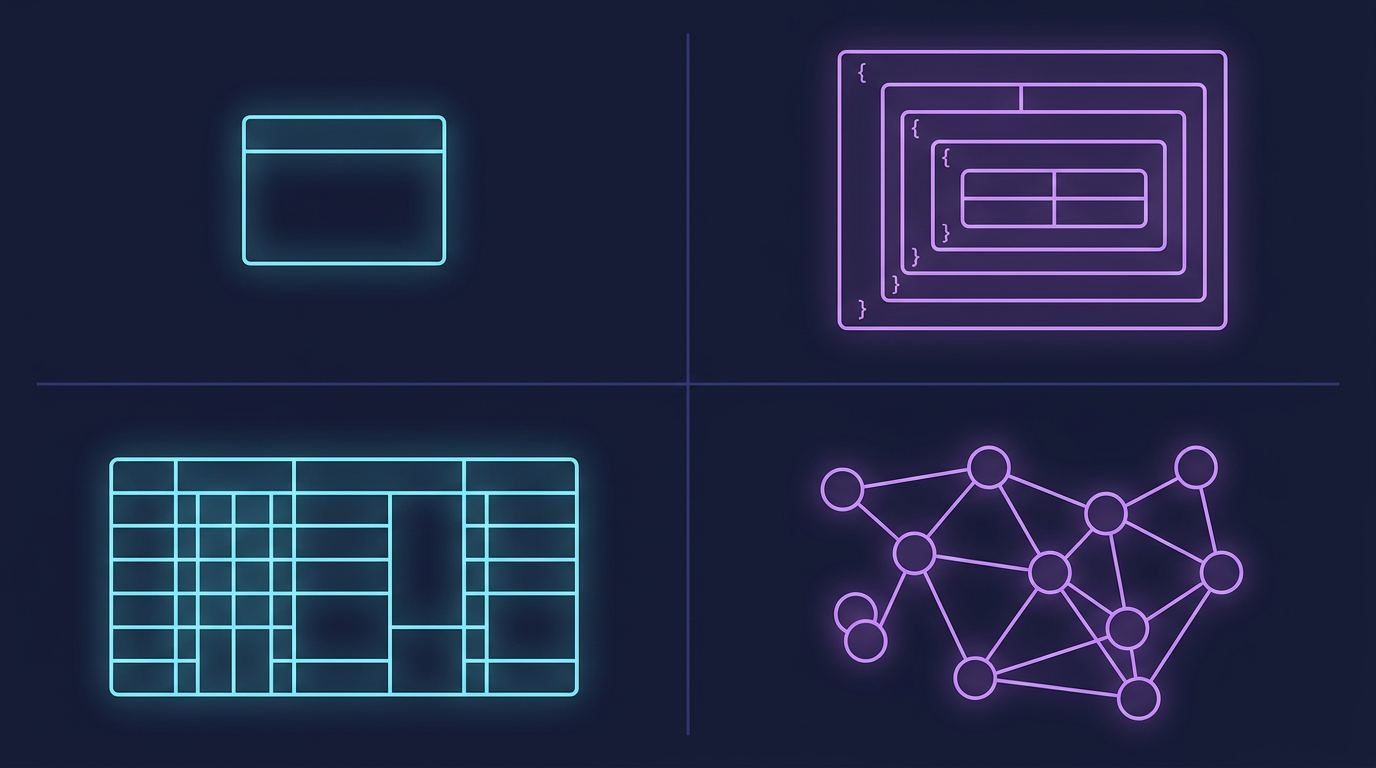
NoSQL does not mean "no structure." It means "no rigid schema imposed at write time." The right NoSQL store matches its data model to your access pattern — not the other way around.
Mind Map
Why NoSQL Exists
Relational databases (Ch09) excel at structured data with complex relationships and strict ACID requirements. But several use cases expose their limits:
| Pressure | Problem with SQL | NoSQL Response |
|---|---|---|
| Schema evolution | ALTER TABLE on 500M rows causes downtime | Schema-flexible documents; add fields without migration |
| Horizontal write scaling | Single-master replication bottlenecks writes | Masterless, multi-writer topologies (Cassandra) |
| Massive throughput | Connection limits, lock contention at scale | Purpose-built for millions of ops/sec |
| Sparse data | NULL-heavy tables waste space | Documents omit absent fields |
| Graph traversal | Recursive JOINs are expensive | Native graph traversal in O(depth), not O(n²) |
| Time-series ingest | Row-per-event at high frequency overwhelms OLTP indexes | Column families optimized for append-heavy workloads |
NoSQL is not a replacement for SQL — it is a set of specialized tools, each optimized for a specific data model and access pattern.
Key-Value Stores
The simplest NoSQL model: a distributed hash map. Every value is addressed by an opaque key. The database does not interpret the value.
Operations: SET key value, GET key, DEL key, EXPIRE key seconds
Complexity: O(1) for all operations (hash table under the hood)
Redis
Redis keeps the entire dataset in memory with optional disk persistence:
- Persistence: RDB snapshots (point-in-time) or AOF (append-only log of every write)
- Data structures: Strings, Lists, Sets, Sorted Sets, Hashes, Streams, Bitmaps, HyperLogLog
- Sorted sets enable leaderboards:
ZADD leaderboard 9500 "alice",ZREVRANGE leaderboard 0 9 - Pub/Sub: lightweight message fanout for real-time notifications
- Atomic operations:
INCR counter,SETNX(set if not exists) for distributed locks
Redis is the backbone of the caching layer described in Ch07 — Caching.
DynamoDB
AWS's fully managed key-value (and document) store:
- Primary key: Partition key alone, or partition key + sort key (composite)
- Sort key enables range queries within a partition:
query(partition="user#42", sort BETWEEN "2024-01" AND "2024-12") - Consistent hashing distributes partitions across storage nodes automatically
- Throughput: Provisioned (RCU/WCU) or on-demand autoscaling
- Global Tables: multi-region active-active with last-write-wins conflict resolution
Key-Value Use Cases
| Use Case | Why Key-Value Fits |
|---|---|
| Session storage | User session is retrieved by session ID — single key lookup |
| Caching | Wrap expensive DB queries; TTL-based invalidation |
| Rate limiting | INCR user:42:req_count + EXPIRE per window |
| Feature flags | GET feature:dark_mode:user:42 → enabled/disabled |
| Leaderboards | Redis Sorted Sets with ZADD/ZREVRANGE |
| Distributed locks | SET lock:resource NX EX 30 (atomic set-if-not-exists) |
Document Stores
Document stores extend key-value by making the value a structured document (typically JSON or BSON). The database can index and query fields inside the document without requiring a fixed schema.
Data model: Collection of documents. Each document is a self-contained JSON object.
// MongoDB document in "users" collection
{
  "_id": "ObjectId(abc123)",
  "name": "Alice Chen",
  "email": "alice@example.com",
  "preferences": {
    "theme": "dark",
    "notifications": ["email", "push"]
  },
  "tags": ["premium", "beta-tester"],
  "created_at": "2024-01-15T10:30:00Z"
}No schema migration needed to add the tags array — existing documents simply lack the field.
MongoDB
- Flexible schema: Documents in the same collection can have different fields
- Aggregation pipeline: Multi-stage transformations (
$match,$group,$lookup,$unwind) - Horizontal scaling: Native sharding with configurable shard keys
- Replication: Replica sets with automatic primary election
$lookup: Left-outer join between collections (use sparingly — document stores are designed to avoid joins)
Document Store Use Cases
| Use Case | Why Document Fits |
|---|---|
| User profiles | Nested preferences, variable attributes per user |
| Product catalogs | Electronics have specs; clothing has sizes — variable schemas |
| Content management | Articles, blog posts — each with different metadata fields |
| Event logs | Each event type has different payload shape |
| E-commerce orders | Embed order lines in order document — read in one query |
Wide-Column Stores
Wide-column stores organize data into column families — a table where each row can have a different set of columns. Optimized for write-heavy, append-heavy, time-series workloads.
Mental model: Think of it as a nested sorted map: table[row_key][column_family][column][timestamp] = value
Cassandra Data Model
Cassandra uses a masterless ring topology with consistent hashing. Every node is equal — there is no primary.
Table example for IoT sensor data:
CREATE TABLE sensor_readings (
    sensor_id  UUID,
    recorded_at TIMESTAMP,
    temperature FLOAT,
    humidity    FLOAT,
    PRIMARY KEY (sensor_id, recorded_at)
) WITH CLUSTERING ORDER BY (recorded_at DESC);- Partition key (
sensor_id) determines which node stores the row - Clustering key (
recorded_at) sorts rows within a partition — enables fast time-range queries - Queries must include the partition key:
WHERE sensor_id = ? AND recorded_at > ?
Tunable Consistency
Cassandra's quorum model lets you trade consistency for availability per query:
| Consistency Level | Write | Read | Trade-off |
|---|---|---|---|
| ONE | Write to 1 node | Read from 1 node | Fastest, lowest durability |
| QUORUM | Write to N/2+1 nodes | Read from N/2+1 nodes | Balanced (default for most workloads) |
| ALL | Write to all nodes | Read from all nodes | Slowest, strongest consistency |
| LOCAL_QUORUM | Quorum within local datacenter | Local DC quorum | Multi-region with local consistency |
This directly maps to the CAP theorem trade-offs discussed in Ch03 — Core Trade-offs. Cassandra defaults to AP — it chooses availability over strict consistency.
Wide-Column Use Cases
| Use Case | Why Wide-Column Fits |
|---|---|
| IoT sensor telemetry | High write throughput; time-ordered queries by device |
| Event logging | Append-only; query by event source + time range |
| Time-series metrics | Infrastructure monitoring; partition by metric name |
| User activity feeds | Partition by user; query recent N events |
| Messaging inbox | Partition by user; cluster by conversation + timestamp |
Graph Databases
Graph databases store data as nodes (entities), edges (relationships), and properties (attributes on both). Traversal — following edges from node to node — is a first-class operation performed in O(depth), independent of total dataset size.
When SQL breaks down: A 6-degree-of-separation query in SQL requires 6 self-joins on a friendships table. At 100M rows, this is prohibitively expensive. In a graph database, it is a single traversal query.
Neo4j and Cypher
Neo4j uses the Cypher query language:
// Find products purchased by people Alice follows (collaborative filtering)
MATCH (alice:User {name: "Alice"})-[:FOLLOWS]->(friend:User)
      -[:PURCHASED]->(product:Product)
WHERE NOT (alice)-[:PURCHASED]->(product)
RETURN product.name, COUNT(friend) AS mutual_purchases
ORDER BY mutual_purchases DESC
LIMIT 10This query would require multiple self-joins and subqueries in SQL.
Graph Database Use Cases
| Use Case | Why Graph Fits |
|---|---|
| Social networks | Followers, friends, mutual connections |
| Recommendation engines | Collaborative filtering via relationship traversal |
| Fraud detection | Ring fraud patterns — accounts connected through shared devices/cards |
| Knowledge graphs | Entity relationships; semantic search |
| Access control | Role hierarchies; permission inheritance |
| Supply chain | Multi-hop dependency tracing |
Comprehensive Comparison Table
| Property | Key-Value | Document | Wide-Column | Graph | SQL (RDBMS) |
|---|---|---|---|---|---|
| Data model | Opaque value by key | JSON/BSON document | Column families | Nodes + edges | Rows + columns |
| Schema | None | Flexible per document | Flexible per row | Semi-structured | Fixed (DDL enforced) |
| Query power | Key lookup only | Field queries + aggregation | Partition + range queries | Traversal + pattern match | Full SQL (JOINs, aggregations) |
| Horizontal scale | Excellent | Good (sharding) | Excellent (built-in) | Limited | Difficult (manual sharding) |
| Consistency | Configurable | Configurable | Tunable (quorum) | Strong (single server) | Strong (ACID) |
| Latency | Sub-ms (in-memory) | Low ms | Low ms | Low ms (shallow traversal) | Low ms (indexed) |
| Transactions | Limited (Redis Lua) | Multi-doc (MongoDB 4+) | Light-weight (LWT) | ACID (Neo4j) | Full ACID |
| Best for | Caching, sessions | Profiles, catalogs | Time-series, events | Relationships, graphs | Financials, reporting |
| Examples | Redis, DynamoDB | MongoDB, CouchDB | Cassandra, HBase | Neo4j, Neptune | PostgreSQL, MySQL |
SQL vs NoSQL Decision Guide
Quick Decision Rules
| Scenario | Recommended |
|---|---|
| Financial transactions, invoices, orders | SQL (ACID mandatory) |
| User profiles with variable attributes | Document (MongoDB) |
| Session and auth tokens | Key-Value (Redis) |
| IoT sensor readings, metrics | Wide-Column (Cassandra) |
| Social graph, recommendations | Graph (Neo4j) |
| Real-time leaderboard | Key-Value (Redis Sorted Sets) |
| Product catalog with varied specs | Document (MongoDB) |
| Audit log / event sourcing | Wide-Column (Cassandra) |
| Fraud detection network | Graph (Neo4j / Neptune) |
| Multi-tenant SaaS with reporting | SQL (PostgreSQL) |
| Semantic / vector similarity search | pgvector (start) → Pinecone / Weaviate (scale) |
CAP Trade-offs in Practice
The CAP theorem (Ch03 — Core Trade-offs) states that a distributed system can guarantee only 2 of 3: Consistency, Availability, Partition Tolerance. Since partition tolerance is required in any real distributed system, the real choice is between C and A.
| Database | CAP Posture | Behavior Under Partition |
|---|---|---|
| PostgreSQL (single node) | CA (no partition tolerance) | Not distributed; no partition scenario |
| MongoDB (default) | CP | Refuses writes until primary is elected |
| HBase | CP | Blocks until ZooKeeper quorum restores |
| Redis Cluster | CP | Slots without quorum reject writes |
| Cassandra | AP | Accepts writes to any available node; reconciles later |
| DynamoDB | AP | Continues serving reads/writes; eventual consistency |
| CouchDB | AP | Multi-master; merges conflicts on sync |
PACELC extension: CAP only describes behavior during a network partition. PACELC adds the trade-off during normal operation: even without a partition, you choose between latency (L) and consistency (C). DynamoDB is AP/EL — it favors availability and low latency over consistency.
Real-World Examples
DynamoDB at Amazon
Amazon's e-commerce platform uses DynamoDB for shopping cart and session state:
- Requirement: Single-digit millisecond reads at any scale — even during Prime Day traffic spikes
- Design: Items stored as documents keyed by
customer_id. Cart operations are atomic item-level updates (UpdateItemwithADDexpressions) - Scale: Tens of millions of requests per second, automatically scaled
- Global Tables: Active-active replication across 5 AWS regions for <10ms latency globally
- Result: Zero downtime during Black Friday; auto-scaling absorbs 10x traffic spikes
The 2007 Amazon Dynamo paper directly inspired DynamoDB's consistent hashing and quorum design.
Cassandra at Netflix
Netflix uses Apache Cassandra for their viewing history and recommendations pipeline:
- Requirement: 100M+ subscribers; viewing events arrive at millions per second
- Data model:
viewing_historypartitioned byuser_id, clustered bywatched_at DESC - Scale: Hundreds of Cassandra nodes across 3 AWS regions
- Consistency:
LOCAL_QUORUM— guarantees consistency within each region; async replication across regions - Why not SQL: At Netflix's write volume, a SQL primary would saturate; Cassandra's masterless topology absorbs writes linearly
- Caching layer: Redis (Ch07) sits in front of Cassandra for recently-watched queries
Vector Search (as of 2026)
Vector search — finding the nearest embeddings to a query vector — has become a standard NoSQL capability, driven by Retrieval-Augmented Generation (RAG) workloads and semantic search.
The landscape in 2026 has consolidated into two practical tiers:
| Tier | Options | Best For |
|---|---|---|
| Embedded / start simple | pgvector (PostgreSQL extension), SQLite-vec | <50M vectors; already on Postgres; lower operational cost |
| Purpose-built vector DB | Pinecone, Weaviate, Qdrant, Milvus | 50M+ vectors, hybrid search, high QPS, dedicated ANN indexes |
Key decision factors:
- pgvector (0.7+ as of 2025): Recommended starting point. Shares your existing Postgres instance, full SQL filtering alongside vector search, no operational overhead. Adequate for most RAG applications under ~10M document chunks.
- Weaviate: Excels at hybrid search (combining BM25 keyword + dense vector scores). Strong choice when metadata filtering is as important as vector similarity.
- Pinecone: Simplest managed option — serverless tier, no infrastructure. Best for teams that want a hosted solution and have budgets for it.
- Qdrant: Open-source, Rust-based, high performance per dollar. Strong self-hosted option.
- Milvus: Best for billions of vectors self-hosted.
Pragmatic pattern for AI applications
Start with pgvector co-located with your existing Postgres database. Only migrate to a purpose-built vector database when you have measured that pgvector's recall accuracy or QPS is insufficient for your production load. This avoids adding a new database technology prematurely.
Both SQL (PostgreSQL via pgvector) and several NoSQL stores (MongoDB Atlas Vector Search, DynamoDB vector preview) have added native vector search, blurring the SQL/NoSQL boundary for this use case.
Key Takeaway
There is no single best database. Match the data model to the access pattern: key-value for O(1) lookups, documents for flexible schemas, wide-column for time-series and high-throughput writes, and graph for traversal-heavy relationship queries. Start with SQL unless you have a specific, measured reason to choose otherwise — and when you do choose NoSQL, pick the type whose data model fits your queries, not the one that is fashionable.
Case Study: Discord's Message Storage Migration
Discord is a real-time chat platform that grew from a gaming community tool to over 500 million registered users sending billions of messages per day. Their message storage history is one of the most cited real-world NoSQL migration stories.
Migration Timeline
Phase 1: MongoDB (2015–2017)
Discord launched on MongoDB, which was a reasonable default for a startup: flexible schema for evolving message payloads, fast development velocity, and familiar to the team.
Why it stopped working:
- By late 2015, the primary MongoDB cluster was storing ~100 million messages
- MongoDB B-Tree indexes for the messages collection no longer fit in RAM
- Random I/O on cold data caused disk seeks — read latency climbed as data grew
- MongoDB's data-size-per-node scaling model did not match Discord's write volume
Phase 2: Apache Cassandra (2017–2022)
Cassandra fit Discord's access pattern: messages are written once, read in time order by channel. Its LSM-Tree storage engine is optimized for sequential writes; its partition model maps naturally to (channel_id, message_id).
Why they chose Cassandra:
- Masterless ring topology — no single-writer bottleneck
- Write throughput scales linearly with nodes
- Time-ordered clustering key (
message_idas Snowflake ID encodes timestamp) enables fast range reads
Why it eventually caused problems:
- Cassandra runs on the JVM. At Discord's write volume, the JVM garbage collector caused GC pause latency spikes — brief but unpredictable freezes during compaction that showed up as tail latency in message delivery
- Compaction pressure was high: Discord's hotspot channels (large gaming servers) created dense partitions that triggered frequent major compactions
- Operational burden: JVM tuning (
-XX:+UseG1GC, heap sizing) required constant adjustment
Phase 3: ScyllaDB (2022–present)
ScyllaDB is a Cassandra-compatible database rewritten in C++ (not Java). It exposes the exact same CQL query language and data model, so Discord could migrate without changing application code.
Why ScyllaDB solved the problems:
- No JVM, no garbage collector — C++ with per-core shard architecture eliminates GC pauses entirely
- Better tail latency consistency (p99 read latency: 40–125ms on Cassandra → ~15ms on ScyllaDB; p99 write: 5–70ms → ~5ms)
- Higher throughput per node → 177 Cassandra nodes replaced by 72 ScyllaDB nodes for the same load
- The migration itself was completed in nine days using a Rust-based migrator processing ~3 million records per second
Database Comparison Table
| Database | Era | Why Chosen | Core Pain Point | When Migrated Away |
|---|---|---|---|---|
| MongoDB | 2015–2017 | Flexible schema, fast prototyping, team familiarity | Random I/O as index outgrew RAM; poor write scaling | 2017 — data volume exceeded sweet spot |
| Apache Cassandra | 2017–2022 | Masterless writes, LSM-Tree efficiency, linear scale | JVM GC pause latency spikes; compaction pressure on hotspot partitions | 2022 — tail latency unacceptable at scale |
| ScyllaDB | 2022–present | Cassandra-compatible CQL; C++ (no GC); per-core sharding | Still evaluating operational maturity | Still in use |
Data Model
The core insight: Discord's query pattern is "give me the last N messages in channel X" — a time-ordered range read within a single channel partition.
-- ScyllaDB / Cassandra CQL
CREATE TABLE messages (
    channel_id   BIGINT,       -- partition key: all messages for a channel are co-located
    message_id   BIGINT,       -- clustering key: Snowflake ID encodes creation timestamp
    author_id    BIGINT,
    content      TEXT,
    attachments  LIST<TEXT>,
    PRIMARY KEY (channel_id, message_id)
) WITH CLUSTERING ORDER BY (message_id DESC);Why Snowflake IDs as clustering key:
- Snowflake IDs are time-sortable 64-bit integers (timestamp in high bits)
- Sorting by
message_id DESCgives chronological ordering for free - Cursor-based pagination:
WHERE channel_id = ? AND message_id < :last_seen_id LIMIT 50 - No
ALLOW FILTERINGneeded — the query is a partition key lookup + clustering range scan
See Ch18 — Unique ID Generation for Snowflake ID internals.
Key Takeaways
- Database choice is not permanent. What works at 10M users (MongoDB) fails at 200M. Architect for migration, not just for today's scale.
- Match storage engine to access pattern. Discord's append-heavy, time-ordered reads are exactly what LSM-Tree (Cassandra/ScyllaDB) is optimized for. B-Tree (MongoDB) was wrong shape for the workload.
- Runtime matters, not just the data model. Cassandra's CQL model was correct; its JVM runtime caused tail latency. ScyllaDB kept the model and replaced the runtime.
- Partition key = unit of co-location. Partitioning messages by
channel_idensures one node owns all messages for a channel — single-node reads, no scatter-gather.
Cross-references: Compare with Ch09 — SQL for why Discord avoided relational DB at this write volume. Snowflake ID generation is covered in Ch18. The full chat system design is in Ch20.
Related Chapters
| Chapter | Relevance |
|---|---|
| Ch09 — SQL Databases | SQL vs NoSQL comparison for data model selection |
| Ch03 — Core Trade-offs | CAP theorem directly drives NoSQL design choices |
| Ch15 — Replication & Consistency | Eventual consistency and replication in NoSQL clusters |
| Ch20 — Chat Messaging | Cassandra as the canonical NoSQL chat storage example |
Practice Questions
Beginner
Key-Value Limits: You store user profiles in Redis as JSON strings, keyed by user ID. A product manager asks: "Can we find all users who signed up in January 2024?" Why is this query fundamentally problematic for a key-value store, and what should you use instead for this access pattern?
Hint
Key-value stores only support point lookups by key — range queries and filtering require a secondary index or a different data model (relational DB or a search index like Elasticsearch).
Intermediate
Cassandra Data Modeling: Design the Cassandra schema for a ride-sharing app's trip history. Specify your partition key and clustering key. What queries does this schema enable efficiently, and what access patterns does it prevent?
Hint
Partition by `driver_id` (or `rider_id`) to colocate a user's trips on the same node; cluster by `trip_start_time DESC` to support "get last N trips" — cross-driver range queries are not supported without a secondary index.CAP Trade-off in Practice: Your chat app uses MongoDB with default write concern. During a network partition, MongoDB refuses writes. A customer complains they cannot send messages. How would you redesign the data layer using a store that prioritizes availability over consistency for this use case?
Hint
AP stores like Cassandra (tunable consistency) or DynamoDB (eventual consistency default) continue accepting writes during partitions — accept that some messages may be temporarily out of order and reconcile on read.Graph vs SQL Performance: You have a fraud detection requirement: "Find all accounts connected within 3 hops via shared phone numbers or devices." Sketch the conceptual SQL (with self-JOINs) vs the conceptual Cypher query. Explain the performance difference at 100M accounts and why SQL degrades superlinearly with hop depth.
Hint
SQL requires N self-joins for N hops (exponential intermediate result set growth); graph databases traverse adjacency lists in constant time per hop, making them orders of magnitude faster for multi-hop traversals.
Advanced
Hybrid Architecture: A fintech company needs: (a) ACID transactions for fund transfers, (b) sub-millisecond session lookups, (c) fraud graph analysis, (d) audit log retention for 7 years at low cost. Specify which database technology handles each requirement, justify each choice, and describe how you keep data consistent across these systems.
Hint
Map requirements to: PostgreSQL (ACID), Redis (sub-ms reads), Neo4j/Neptune (graph traversal), S3 + Athena or ClickHouse (cold audit logs) — use event sourcing or CDC (Debezium) to propagate writes across stores.
Next: Chapter 11 — Message Queues →Previous: Chapter 09 — Databases: SQL ←
References & Further Reading
- "Designing Data-Intensive Applications" — Chapters 2, 5 (Data Models, Replication)
- MongoDB documentation
- Apache Cassandra Architecture Guide
- Amazon DynamoDB Developer Guide
- "Dynamo: Amazon's Highly Available Key-Value Store" — DeCandia et al.
Comments powered by Giscus. Enable GitHub Discussions on the repo to activate.