
Chapter 13: Microservices Architecture
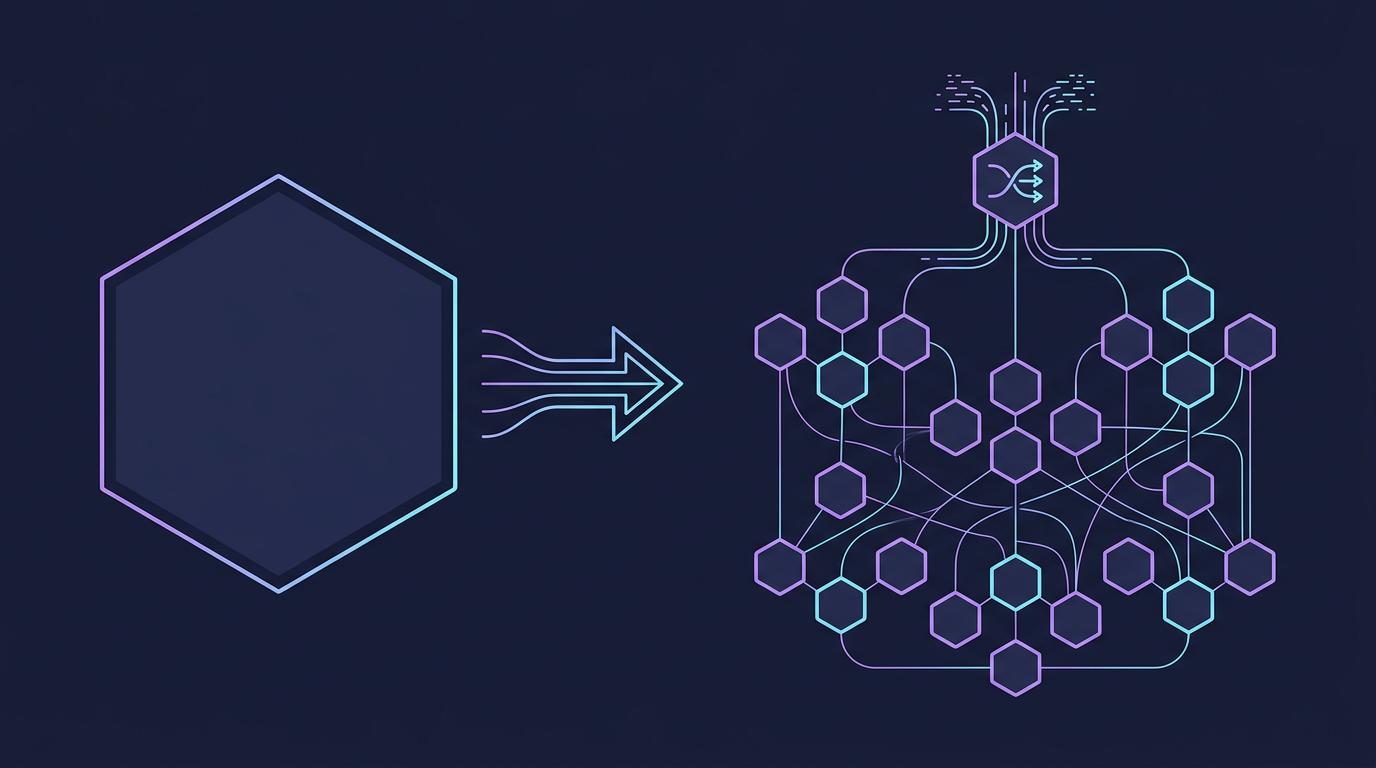
The goal of microservices is not to make systems more complex — it is to make complexity manageable by assigning clear ownership. A well-designed microservices system is harder to build than a monolith, but far easier to evolve.
Mind Map
Monolith vs Microservices
Before choosing microservices, you must understand what you are trading away — and what you gain. Neither architecture is universally correct; the right choice depends on team size, deployment velocity requirements, and domain complexity.
Architecture Comparison
Comparison Table
| Dimension | Monolith | Microservices |
|---|---|---|
| Deployment | Single unit — all-or-nothing releases | Independent — each service deploys separately |
| Scaling | Scale entire app even for one bottleneck | Scale individual services to demand |
| Complexity | Simple locally, complex as codebase grows | High operational complexity from day one |
| Team Autonomy | Shared codebase creates coordination overhead | Teams own their services end-to-end |
| Data Ownership | Shared database — easy joins, tight coupling | Each service owns its data — loose coupling |
| Testing | Straightforward integration testing | Service mocking, contract testing required |
| Latency | In-process calls (nanoseconds) | Network calls (milliseconds) per hop |
| Fault Isolation | One bug can crash the entire application | Failures are contained to individual services |
| Time to Market | Fast for small teams; slows with scale | Slower initial setup; faster long-term velocity |
| Observability | Single log stream, simpler tracing | Distributed tracing required (see Chapter 17) |
Rule of thumb: Start with a well-structured monolith. Migrate to microservices when team size, deployment frequency, or scaling requirements genuinely justify the operational overhead. Amazon's rule: if a single team can't be fed with two pizzas, the service is too large.
Service Discovery
In a microservices system, service instances start and stop dynamically — containers are rescheduled, pods restart, and IP addresses change constantly. Service discovery solves the problem of how services find each other without hardcoded addresses.
Client-Side Discovery
The client is responsible for querying the service registry and selecting an instance using a load-balancing strategy (round-robin, least-connections, etc.).
Tools: Netflix Eureka, HashiCorp Consul, Apache Zookeeper
Tradeoff: Client gains control over load-balancing logic but must embed discovery logic in every service. Client libraries become a coupling point.
Server-Side Discovery
The client sends requests to a load balancer or router. The router queries the service registry and forwards the request to the appropriate instance. The client knows nothing about discovery.
Tools: AWS ALB with ECS service discovery, Kubernetes DNS + kube-proxy, NGINX Plus
Tradeoff: Simpler clients, but the load balancer becomes a critical path component. Kubernetes uses this model natively — a Service object gets a stable DNS name (order-service.default.svc.cluster.local) that resolves to the active pods.
Service Registry Tools
| Tool | Model | Consensus | Best For |
|---|---|---|---|
| Consul | CP (strong consistency) | Raft | Multi-datacenter, health checking, KV store |
| etcd | CP | Raft | Kubernetes backing store, configuration |
| Zookeeper | CP | ZAB | Legacy Hadoop/Kafka ecosystems |
| Kubernetes DNS | DNS-based | N/A (backed by etcd) | Native Kubernetes workloads |
| Eureka | AP (availability-first) | None | Netflix OSS stack, eventual consistency acceptable |
API Gateway
An API Gateway is the single entry point for all client traffic. Instead of exposing dozens of service URLs to clients, the gateway presents a unified facade and handles cross-cutting concerns so individual services don't have to.
Responsibilities
- Routing — maps public paths to internal service endpoints
- Authentication & Authorization — validates JWTs, API keys, OAuth tokens before traffic reaches services
- Rate Limiting — protects services from traffic spikes (see Chapter 16)
- Request Aggregation — fan-out to multiple services and compose a single response
- Protocol Translation — converts external REST calls to internal gRPC calls
- SSL Termination — decrypts HTTPS at the gateway; internal traffic uses plain HTTP or mutual TLS (mTLS) via service mesh
Gateway Traffic Flow
Tools: AWS API Gateway, Kong, NGINX, Envoy, Traefik, Spring Cloud Gateway
Backend for Frontend (BFF) Pattern
A single API Gateway serving both mobile and web clients creates tension — mobile needs compact payloads, web needs richer data. The BFF pattern creates a dedicated gateway per client type, allowing each to evolve independently.
Real-world: Netflix maintains separate BFFs for TV, mobile, and web — each optimized for its device's screen size, network conditions, and interaction model.
Inter-Service Communication
Services must communicate. The choice between synchronous and asynchronous communication affects latency, coupling, and fault tolerance.
Synchronous Communication
The caller blocks and waits for a response. Simple to reason about but creates temporal coupling — if the downstream service is slow or unavailable, the caller is affected.
- REST over HTTP/1.1 or HTTP/2 — widely understood, good tooling, cache-friendly. Best for CRUD-style interactions with external or public-facing services. See Chapter 12 for HTTP deep-dive.
- gRPC — Protocol Buffers + HTTP/2. Strongly typed, efficient binary serialization, supports streaming. Best for internal service-to-service calls where performance matters. See Chapter 12 for gRPC deep-dive.
Asynchronous Communication
The caller publishes an event or message and continues execution. The downstream service processes the message independently. Decouples services in time and increases resilience.
- Message queues (point-to-point) — one producer, one consumer. Durable delivery. Best for task delegation (e.g., send email, process image). See Chapter 11 for message queue deep-dive.
- Event bus (pub/sub) — one producer, many consumers. Best for broadcasting domain events to multiple subscribers. See Chapter 14 for event-driven patterns.
Communication Comparison Table
| Dimension | REST | gRPC | Message Queue | Event Bus |
|---|---|---|---|---|
| Coupling | Temporal + interface | Temporal + strict types | Decoupled | Fully decoupled |
| Latency | Low (ms) | Very low (ms, binary) | Higher (async) | Higher (async) |
| Payload | JSON (human-readable) | Protobuf (binary, compact) | Any format | Any format |
| Type Safety | Optional (OpenAPI) | Strong (.proto schema) | Schema optional | Schema optional |
| Streaming | Limited (chunked transfer) | Native (4 modes) | Pull-based | Push-based |
| Error Handling | HTTP status codes | gRPC status codes | Dead-letter queues | Event replay |
| Use Case | Public APIs, CRUD | Internal high-perf calls | Task queues | Domain events |
Circuit Breaker Pattern
When Service A calls Service B synchronously, a slow or failing Service B will cause Service A's threads to pile up waiting for responses. Under load, this cascades — Service A's connection pool exhausts, its own latency rises, and the failure propagates upstream. The circuit breaker prevents this cascade.
States
Closed: Normal operation. Requests pass through. Failures are counted in a rolling window.
Open: Failure threshold exceeded. Requests are rejected immediately (fail fast) without calling the downstream service. A fallback response (cached data, default value, error) is returned. The downstream service gets time to recover.
Half-Open: After a configurable timeout, a small number of probe requests are allowed through. If they succeed, the circuit closes. If they fail, the circuit reopens.
Implementation
// Pseudocode: Circuit Breaker logic
function callWithCircuitBreaker(serviceCall, circuitBreaker):
    if circuitBreaker.state == OPEN:
        if circuitBreaker.timeoutElapsed():
            circuitBreaker.state = HALF_OPEN
        else:
            return fallbackResponse()  // fail fast

    try:
        response = serviceCall()
        circuitBreaker.recordSuccess()
        if circuitBreaker.state == HALF_OPEN:
            circuitBreaker.state = CLOSED
        return response
    catch Exception:
        circuitBreaker.recordFailure()
        if circuitBreaker.failureRateExceeds(threshold):
            circuitBreaker.state = OPEN
throwLibraries: Netflix Hystrix (now in maintenance), Resilience4j (JVM), Polly (.NET), circuitbreaker package (Go), pybreaker (Python).
Real-world: Netflix's Hystrix was born from a real incident — a single downstream service's degradation caused their entire API to become unresponsive. By wrapping every external call in a circuit breaker, Netflix guarantees that no single service failure can take down the API tier.
Saga Pattern for Distributed Transactions
In a monolith with a shared database, a multi-step operation (place order → reserve inventory → charge payment → send confirmation) can be wrapped in a single ACID transaction. In microservices, each service owns its own database — there is no distributed ACID transaction.
The Saga pattern breaks a distributed transaction into a sequence of local transactions. Each step publishes an event or sends a command to trigger the next step. If a step fails, compensating transactions are executed in reverse to undo completed steps.
Choreography-Based Saga
No central coordinator. Each service listens for events and decides what to do next. Services are fully decoupled.
Advantages: No single point of failure, fully decoupled, easy to add new participants. Disadvantages: Hard to track overall transaction state; debugging requires tracing events across multiple services.
Orchestration-Based Saga
A central Saga Orchestrator drives the process by sending commands to each service and waiting for responses.
Choreography vs Orchestration
| Dimension | Choreography | Orchestration |
|---|---|---|
| Coordination | Implicit via events | Explicit — central orchestrator |
| Coupling | Low — services only know events | Medium — services know orchestrator protocol |
| Visibility | Low — state distributed across services | High — orchestrator holds full state |
| Debugging | Hard — must trace events across logs | Easier — orchestrator logs full saga state |
| Single Point of Failure | None | Orchestrator (mitigate with high availability) |
| Best For | Simple, stable flows with few participants | Complex flows, many compensations, regulatory audit requirements |
Cross-reference: Choreography-based sagas rely on event-driven patterns covered in Chapter 14.
Service Mesh
As the number of microservices grows, cross-cutting networking concerns — mutual TLS, retries, timeouts, circuit breaking, observability — are duplicated in every service. A service mesh externalizes these concerns from application code into a dedicated infrastructure layer.
Sidecar Proxy Pattern
Every service instance gets a co-located sidecar proxy (e.g., Envoy). All inbound and outbound network traffic flows through the proxy, not directly to the service. The application code is unaware of the mesh.
What a Service Mesh Handles
| Concern | Without Mesh | With Mesh |
|---|---|---|
| mTLS encryption | Each service implements TLS | Sidecar handles cert rotation automatically |
| Retries & timeouts | Embedded in each service's HTTP client | Configured in mesh policy, applied uniformly |
| Circuit breaking | Each service integrates Resilience4j | Configured once in mesh, applied to all |
| Load balancing | Client-side or DNS round-robin | Sidecar uses L7 policies (least-request, zone-aware) |
| Distributed tracing | Manual instrumentation per service | Automatic trace propagation via headers |
| Traffic splitting | Custom code or feature flags | Mesh policy (e.g., 10% canary, 90% stable) |
| Observability | Each service emits metrics manually | Golden signals (latency, errors, saturation) auto-generated |
Tools: Istio (most feature-rich, higher complexity), Linkerd (lightweight, simpler operational model), Consul Connect, AWS App Mesh.
When to use a service mesh: Justified at 10+ services when operational burden of per-service networking logic exceeds the complexity of running the mesh itself. Avoid premature adoption — the control plane adds real operational overhead.
Service Mesh Evolution: Sidecar → Ambient Mode (2026)
The sidecar model has a well-understood cost: every pod gets an Envoy proxy, adding ~50MB RAM per pod and an extra network hop to every inbound and outbound call. At 1,000 pods, that's 50 GB of memory consumed purely by proxies.
Istio Ambient Mode, entering early production adoption in 2026, eliminates per-pod sidecars entirely. Instead, networking is handled by two shared components:
- ztunnel — a per-node L4 proxy (DaemonSet) that handles mTLS encryption and basic routing for all pods on the node. One process per node instead of one sidecar per pod.
- Waypoint proxy — an optional per-namespace/service Envoy that handles L7 policy (authorization, retries, traffic splitting) only when needed. Deployed on demand, not by default.
Performance gains vs sidecar Istio (production measurements, 2026):
| Metric | Sidecar Istio | Ambient Mode | Improvement |
|---|---|---|---|
| Memory per service | ~50 MB (Envoy sidecar) | ~3 MB (ztunnel share) | ~90% reduction |
| Added latency | 5–10ms (extra hop) | ~1ms (kernel-level) | ~25% reduction |
| CPU overhead per pod | 5–15% | <1% (eBPF assist) | ~75% reduction |
| Deployment complexity | Sidecar injection per pod | DaemonSet + on-demand waypoints | Simpler |
Cilium integration: Ambient mode can use Cilium's eBPF data plane for the L4 layer instead of ztunnel, pushing mTLS enforcement into the kernel and reducing overhead further. This Cilium + ambient Istio combination is the emerging "best of both worlds" pattern for 2026 Kubernetes deployments.
Migration path: Ambient mode is opt-in per namespace — istio.io/dataplane-mode: ambient label. Existing sidecar namespaces continue unchanged, enabling incremental migration.
When to Choose Ambient Mode
If you are starting a new Kubernetes cluster in 2026 or have >200 pods on sidecar Istio, evaluate ambient mode. The memory and CPU savings at scale are substantial. For clusters under ~50 pods, the operational difference is smaller — existing sidecar deployments are stable and do not need immediate migration.
Decomposition Strategies
Deciding where to draw service boundaries is the hardest part of microservices design. Poor boundaries create chatty, tightly-coupled services worse than the monolith they replaced.
Decompose by Business Capability
Organize services around what the business does, not how the technology is structured.
A typical e-commerce system decomposed by business capability:
├── Catalog Service      (product listing, search, pricing)
├── Order Service        (order placement, order history)
├── Inventory Service    (stock levels, reservations)
├── Payment Service      (charging, refunds, fraud detection)
├── Shipping Service     (fulfillment, tracking)
├── Notification Service (email, SMS, push)
└── Identity Service (auth, user profiles)Each service maps to a business function owned by a single team. The team controls the full stack: schema, code, deployment, on-call rotation.
Decompose by Subdomain (Domain-Driven Design)
DDD introduces Bounded Contexts — explicit boundaries around a domain model. Within a bounded context, terms have precise meanings. Across boundaries, models are translated via anti-corruption layers.
A "Customer" in the Order subdomain (name, shipping address, loyalty tier) is different from a "Customer" in the Billing subdomain (billing address, payment methods, credit limit). DDD makes these differences explicit and prevents one team's model from leaking into another's.
Bounded context = natural service boundary.
Strangler Fig Pattern
Migrating a large monolith to microservices all at once is high-risk. The Strangler Fig pattern migrates incrementally:
- Place a routing layer (API gateway or reverse proxy) in front of the monolith
- Identify a bounded context to extract first (choose low-risk, high-change-frequency)
- Implement the new microservice in parallel
- Route traffic for that domain to the new service
- Delete the corresponding code from the monolith
- Repeat until the monolith is empty — or small enough to keep
The strangler fig — a tropical plant that grows around a host tree, eventually replacing it — is the namesake of this pattern. Amazon, LinkedIn, and Airbnb all used variants of this approach.
Platform Engineering and Internal Developer Platforms
As microservices organizations scale past ~50 services, a new problem emerges: each team reinvents the same infrastructure — Kubernetes YAML, CI/CD pipelines, service observability wiring, secret management. The cognitive overhead per developer climbs as the platform sprawl grows.
Platform engineering addresses this by treating the internal developer platform (IDP) as a product. A platform team builds and maintains the "golden path" — pre-wired templates, self-service provisioning, and curated tooling — so product teams can ship services without becoming Kubernetes experts.
Backstage (open-sourced by Spotify, now a CNCF incubating project) is the most adopted framework for building IDPs in 2026. It provides:
- Service catalog — a searchable registry of every service, its owner, SLOs, runbooks, API docs, and dependencies. Replaces scattered wikis with a single pane of glass.
- Software templates — "scaffolder" templates that generate a new microservice repository with all required boilerplate: CI/CD, Dockerfile, health check endpoints, OTel instrumentation, and Kubernetes manifests.
- Tech radar — an opinionated view of approved vs. deprecated technologies, reducing "which library should I use?" decision sprawl.
- Plugin ecosystem — 200+ plugins connect Backstage to PagerDuty, Datadog, GitHub Actions, ArgoCD, Vault, and more.
Platform Engineering as the 2026 Microservices Operating Model
The shift in 2026 is from each team owning their own infrastructure configuration to platform teams owning the abstraction layer. This does not reduce autonomy — teams still own their service code — but it eliminates the operational tax of low-level Kubernetes/networking expertise from every team. Large-scale microservices organizations (Spotify, Airbnb, Shopify) have validated that platform investment reduces new-service time-to-production from weeks to hours.
Cell-based architecture is an emerging complementary resilience pattern: rather than one large cluster of microservices, the system is partitioned into independent "cells" (e.g., by customer shard or geographic zone). A failure in one cell is blast-radius-contained, never propagating to all cells. This is conceptually an extension of the bulkhead pattern applied at the organizational/cluster level.
Real-World Examples
Netflix: 600+ Microservices
Netflix operates one of the most cited microservices deployments in the industry. Starting as a DVD rental monolith, Netflix began its cloud migration in 2008 and completed it by 2016. Today:
- 600+ microservices handle video streaming, recommendations, billing, and device management
- Each team owns 2–5 services end-to-end (deploy, operate, on-call)
- Eureka handles service discovery across multiple AWS regions
- Hystrix circuit breakers (now largely replaced by Resilience4j) isolate failures
- Zuul and later Spring Cloud Gateway serve as the API gateway layer
- Custom chaos engineering tooling (Chaos Monkey) randomly terminates production services to prove resilience
Key lesson: Netflix's microservices investment paid off in deployment velocity — teams deploy hundreds of times per day with independent release cycles — but required massive investment in tooling, observability, and operational culture.
Amazon: The Two-Pizza Team Rule
Amazon's CEO Jeff Bezos mandated in the early 2000s that every team must be small enough to be fed by two pizzas (~6–8 people). This rule drove the decomposition of Amazon's monolith into services that later became AWS primitives.
Every team owns its service like a product: API contract, data store, deployment pipeline, SLA. Teams communicate only through APIs — no shared databases, no shared libraries beyond approved utilities.
The result: Amazon can deploy to production every 11.6 seconds on average, with thousands of teams operating independently.
Key Takeaway
Microservices trade operational complexity for organizational scalability. A monolith is simpler to build and run at small scale; microservices become necessary when independent deployability, team autonomy, and fault isolation justify the overhead of distributed systems. Get service boundaries right by following business capabilities and DDD bounded contexts — wrong boundaries create a distributed monolith that has all the costs and none of the benefits. Invest in the platform (service discovery, API gateway, observability, circuit breakers) before you invest in splitting services.
Service Discovery Deep-Dive
The existing section covers the two models at a high level. This section goes deeper into implementation details and failure modes.
Multi-Region Service Discovery
In multi-region deployments, service discovery must balance routing traffic to the nearest healthy instance against cross-region failover when an entire region goes down.
| Strategy | How It Works | Latency | Failover |
|---|---|---|---|
| Local-first (zone-aware) | Registry returns instances in same AZ/region first | Lowest | Automatic fallback to remote zone if local unhealthy |
| Global load balancer | DNS-based (Route 53 latency routing, Cloudflare) routes to nearest region | Low | Automatic via DNS health checks |
| Federated registries | Each region has its own Consul/etcd cluster; cross-region lookup over WAN | Medium | Manual or scripted failover |
| Service mesh multi-cluster | Istio or Linkerd cross-cluster service discovery via trust bundles | Low | Policy-driven; transparent to services |
Kubernetes multi-cluster: ServiceImport / ServiceExport (MCS API) allows a service in cluster A to be discovered by services in cluster B without shared DNS, using a multi-cluster gateway to route traffic.
Client-Side vs Server-Side Discovery
| Pattern | Pros | Cons | Example |
|---|---|---|---|
| Client-Side | Fine-grained load-balancing control, no extra hop | Discovery logic in every client; language-specific SDKs required | Netflix Eureka + Ribbon |
| Server-Side | Clients are simple; centralized routing policy | Router is a critical path dependency; extra network hop | Kubernetes DNS + kube-proxy |
| DNS-based | Universal client support; no SDK needed | Low TTL required for fast updates; no health-aware routing | AWS Route 53, Consul DNS |
| Service Mesh | Transparent to app code; policy-driven | Operational overhead of control plane | Istio, Linkerd |
Service Registry Comparison
Choosing a service registry depends on your consistency requirements, existing ecosystem, and operational complexity budget.
| Tool | Protocol | Consistency | Health Check | Watches / Notifications | Language Support | Best For |
|---|---|---|---|---|---|---|
| Consul | HTTP + DNS | CP (Raft) | HTTP, TCP, gRPC, script | Yes (blocking queries) | All via HTTP | Multi-DC, health-aware routing, KV store |
| etcd | gRPC (HTTP/2) | CP (Raft) | Lease TTL (client heartbeat) | Yes (watch API) | All via gRPC | Kubernetes backing store, config management |
| Eureka | REST (HTTP) | AP (no consensus) | HTTP heartbeat every 30s | Polling only | JVM-first; REST for others | Netflix OSS stack; availability over consistency |
| ZooKeeper | Custom binary | CP (ZAB) | Session timeout (ephemeral znodes) | Yes (watches on znodes) | Java-first | Legacy Kafka/Hadoop; strong consistency required |
Consistency trade-off in practice:
- Consul/etcd (CP): During a network partition, the minority partition stops serving writes. Services cannot register or deregister — they may return stale data or be unavailable.
- Eureka (AP): During a partition, Eureka nodes continue serving cached data. A service may appear registered even after it has crashed (30–90s stale window). Netflix accepted this: a stale entry causing a failed request is better than a complete outage.
Service Registration Flow
Self-registration vs third-party registration:
- Self-registration: The service itself calls the registry on startup and deregisters on shutdown (graceful). Simple, but requires registry client logic in each service.
- Third-party registration: An external observer (Kubernetes controller, Consul agent, ECS service scheduler) registers and deregisters on behalf of the service. The service code stays registry-agnostic.
Cross-reference: Chapter 6 — Load Balancing covers the load-balancing algorithms (round-robin, least-connections, consistent hashing) that client-side discovery uses to pick instances. Chapter 23 covers Kubernetes DNS, which implements server-side discovery natively.
Health Check Patterns
Service registries only provide value if they reflect the true health of each instance. Three probe types cover different failure modes:
| Probe Type | Question Answered | Failure Action | Typical Check |
|---|---|---|---|
| Startup | Has the app finished initializing? | Kill and restart | HTTP 200 on /healthz/startup |
| Liveness | Is the app alive (not deadlocked/OOM)? | Kill and restart | HTTP 200 on /healthz/live |
| Readiness | Is the app ready to serve traffic? | Remove from load balancer (do NOT restart) | Check DB connection, cache, downstream deps |
Key distinction — readiness vs liveness: A service can be alive but not ready. If the database connection pool is exhausted, the service is liveness-healthy (process is running, no deadlock) but readiness-unhealthy (cannot serve requests). The right action is to pull it from the load balancer, not kill it. Confusing the two probes causes unnecessary restarts under load.
Deep health checks: Expose a /health/detailed endpoint that reports sub-component status (database, cache, downstream services). Use it for dashboards and alerting. Liveness probes should be shallow (process-level only) to avoid cascading restarts when a dependency flaps.
Health Check Anti-Patterns
| Anti-Pattern | Problem | Fix |
|---|---|---|
| Readiness checks all dependencies | One flapping downstream dep marks entire service unready; cascading removal from load balancer | Check only critical dependencies; use circuit breaker for non-critical ones |
| Liveness checks include DB | DB timeout triggers container restart loop; connection pool exhaustion self-heals, restarts do not | Liveness = process-only; readiness = dependency-aware |
| No startup probe (slow init) | Liveness fires before app finishes initializing; container killed in infinite restart loop | Add startup probe with failureThreshold * periodSeconds > max_init_time |
| Too-short TTL + slow check | Health check RTT > TTL → instance flaps between healthy/unhealthy under load | Set TTL ≥ 3× check interval; use deregister-critical-service-after for graceful cleanup |
API Versioning Strategies
API versioning is how you evolve your service contracts without breaking existing consumers. There is no universally correct strategy — the right choice depends on client types and change frequency.
| Strategy | Format | Caching | Client Complexity | Breaking Changes | Example |
|---|---|---|---|---|---|
| URL Path | /v1/users, /v2/users | Excellent (URL is cache key) | Low — explicit, visible | Clean — old and new coexist | Most REST APIs |
| Query Parameter | /users?version=2 | Good | Low | Same as URL path | Some Google APIs |
| Request Header | API-Version: 2024-01-01 | Poor (cache key doesn't include headers by default) | Medium — must set header | Requires header-aware proxies | Stripe, GitHub |
| Content Negotiation | Accept: application/vnd.myapp.v2+json | Poor | High — non-standard | Semantically correct per HTTP spec | Rare in practice |
| Consumer-Driven Contracts | Pact-style contract tests | N/A | Low | Detected before deployment | Internal microservices |
Backward compatibility best practices:
- Never remove a field — mark it deprecated, keep it populated for ≥6 months
- Never change field semantics —
totalchanging from gross to net is a breaking change even if the field name stays the same - Add fields as optional — new fields must have safe defaults; consumers must tolerate unknown fields
- Use sunset headers —
Sunset: Sat, 01 Jan 2026 00:00:00 GMTin responses to deprecated versions gives consumers a machine-readable deadline - Run versions in parallel — use the strangler fig approach at the API level: route
/v1to old handlers,/v2to new handlers, retire/v1once all consumers migrate
Versioning in event contracts: The same principles apply to event schemas — see Chapter 14 for schema evolution and schema registry patterns.
API Version Lifecycle
Internal vs External Versioning
Internal microservices (service-to-service) can use a lighter versioning strategy than public APIs:
| Context | Recommended Strategy | Reason |
|---|---|---|
| Public API (third-party, mobile apps) | URL path versioning (/v1) | Explicit, cacheable, discoverable; clients may not update quickly |
| Internal services (known consumers) | Consumer-driven contracts (Pact) + additive-only changes | Detect breaking changes at CI time; avoid URL proliferation |
| Event schemas | Schema registry with compatibility rules | Enforce backward compatibility before publishing to topic |
| gRPC internal APIs | Protobuf field numbers (never change); add new fields, deprecate old | Protobuf is naturally backward/forward compatible if field numbers are preserved |
Code Example: gRPC Service Definition
// user_service.proto
syntax = "proto3";
package user;

service UserService {
  rpc GetUser(GetUserRequest) returns (User);
  rpc ListUsers(ListUsersRequest) returns (stream User);  // server streaming
  rpc CreateUser(CreateUserRequest) returns (User);
}

message GetUserRequest {
  string user_id = 1;
}

message User {
  string id = 1;
  string name = 2;
  string email = 3;
  int64 created_at = 4;
}// gRPC server implementation (Go)
type userServer struct {
pb.UnimplementedUserServiceServer
db *sql.DB
}
func (s *userServer) GetUser(ctx context.Context, req *pb.GetUserRequest) (*pb.User, error) {
user, err := s.db.QueryRow("SELECT id, name, email FROM users WHERE id = $1", req.UserId)
if err != nil {
return nil, status.Errorf(codes.NotFound, "user not found: %s", req.UserId)
}
return &pb.User{Id: user.Id, Name: user.Name, Email: user.Email}, nil
}Related Chapters
| Chapter | Relevance |
|---|---|
| Ch06 — Load Balancing | API gateway is a specialized LB for service mesh routing |
| Ch11 — Message Queues | Async inter-service communication via Kafka/SQS |
| Ch14 — Event-Driven Architecture | Saga pattern for distributed transactions across services |
| Ch15 — Replication & Consistency | Per-service database consistency in a microservices system |
| Ch23 — Cloud-Native | Kubernetes orchestration for microservice deployments |
Practice Questions
Beginner
Strangler Fig Migration: An e-commerce startup wants to decompose their monolith. They have a single
userstable joined in 15 places. Describe the strangler fig migration strategy step by step. Which service would you extract first and why? What is the risk if you try to extract theusersservice first?Hint
Extract services with the fewest inbound dependencies first (leaf services like email notifications); extracting a heavily-joined entity like `users` first creates a distributed monolith with synchronous coupling everywhere.
Intermediate
Circuit Breaker Tuning: Your payment service has a circuit breaker with a 50% failure threshold over 10 seconds and a 30-second open timeout. During a flash sale, the payment processor becomes slow (P99 = 8s) but returns 200 OK. Explain why the circuit breaker does not trip, and what additional resilience mechanism (timeout + bulkhead) you would add.
Hint
The circuit breaker counts failures, not slowness — add a request timeout (e.g., 2s) so slow responses are classified as failures, allowing the circuit breaker to trip and shed load during latency spikes.Saga Compensation: You are building a travel booking system that must atomically book a flight, hotel, and car rental across three external APIs. Compare choreography vs orchestration sagas for this use case. Which do you choose, and how do you handle the car rental being unavailable after flight and hotel are already confirmed?
Hint
Orchestration is clearer for complex compensations with explicit rollback sequences; when car rental fails, the orchestrator explicitly calls the hotel and flight cancellation APIs in reverse order.Service Mesh Decision: Your team runs 8 microservices and security requires mTLS between all services. A senior engineer proposes Istio; a skeptic says it's too complex. What criteria (team size, service count, compliance requirements, existing tooling) would you use to decide? At what scale does a service mesh clearly pay for itself?
Hint
Evaluate: does your team have the Kubernetes expertise to operate Istio? Are you implementing mTLS, circuit breaking, or traffic splitting in every service's code already? If yes to both, a mesh reduces per-service complexity.
Advanced
API Gateway vs BFF: A fintech company has three client types: a web dashboard (data-heavy, many charts), a mobile app (bandwidth-constrained), and a partner API (versioned, metered). Design the gateway layer. Would you use a single API gateway or Backend-for-Frontend (BFF)? Describe what each BFF would do differently from the others.
Hint
BFF is justified when clients have meaningfully different data-shaping needs (web = large aggregated responses, mobile = minimal payloads, partner = versioned contracts with rate limiting) — a single gateway forces all clients to over-fetch or under-fetch.
References & Further Reading
- "Building Microservices" — Sam Newman
- "Microservices Patterns" — Chris Richardson
- gRPC documentation
- Netflix Microservices blog series
- "The Twelve-Factor App"
Comments powered by Giscus. Enable GitHub Discussions on the repo to activate.